Competitor Analysis: How to Beat Your Competitor and Rank Better
Competitors can rank for keywords you miss, explain their product more clearly, or show up in AI-generated answers where your brand doesn't. RankAnalyze's Head-to-Head report compares your chosen product against a competitor's — and attaches the evidence behind every gap, so you know what to investigate or fix next.
What Is Competitor Analysis?
Competitor analysis is the practice of systematically comparing your product, website or positioning against a rival's — not casually browsing their site, but pulling specific, comparable evidence: what keywords they rank for, what they claim, what they charge, how they're reviewed, and where their technical setup differs from yours. Done well, it turns "what are they doing" into a short list of things worth acting on — the same categories a Head-to-Head report is organized around: search visibility, product features, messaging, pricing and site structure.
How to Do Competitor Analysis in 5 Steps
- Identify your real competitors — the ones actually competing for the same buyers, not everyone loosely in your market.
- Choose what to compare — keywords, features, pricing, messaging, trust signals — not everything a competitor publishes.
- Gather evidence for each comparison point — a screenshot, URL, quote or dated figure, not an impression.
- Validate what you find — confirm anything high-impact before you act on it or put it in a report.
- Prioritize and act — not every gap deserves a response; rank by relevance, evidence and effort.
That's the method in brief. The full breakdown of each step — including how to pick competitors, what's worth comparing, and how to validate evidence — is covered in depth in our competitor analysis guide. Here's how RankAnalyze runs this same process for you automatically.
What to Look for in a Competitor Analysis Tool
Not all competitor analysis tools do the same job. A few things separate a tool that produces real decisions from one that produces a pile of data:
- Evidence behind each finding — a claim like "you're behind on pricing" is only useful if you can see exactly what was checked and why, not just a score.
- Precise product-to-product comparisons — if either company sells more than one product, a tool that only compares whole domains will blur unrelated product lines together.
- SEO and content gap analysis — keyword and content gaps tied to real search volume, not just a list of "topics they cover."
- AI search visibility — whether you (or your competitor) get cited in AI-generated answers, not only classic Google rankings.
- Clear recommendations, not just scores — a number tells you where you stand; a recommendation tells you what to do about it.
How RankAnalyze Does Competitor Analysis
Step 1: Add Your Page and Competitor Pages
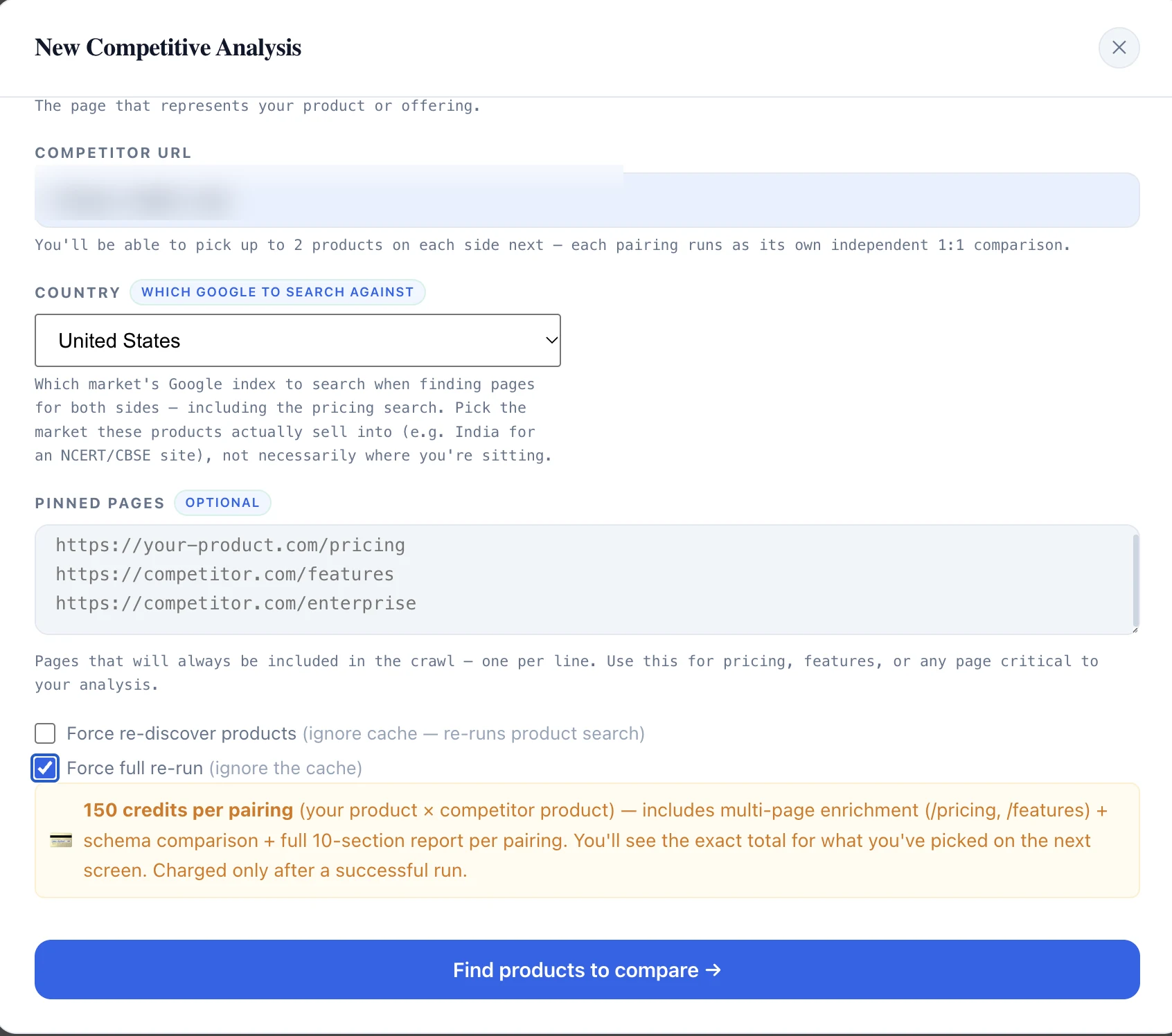
Paste the URL of the page that represents your product, then a competitor's URL. Use specific pages — /pricing, /features — rather than homepages; the more directly comparable the two pages, the sharper the analysis. You can also pin pages that should always be included in the crawl, and choose the country whose Google index to search against.
Step 2: Select the Products You Want to Compare
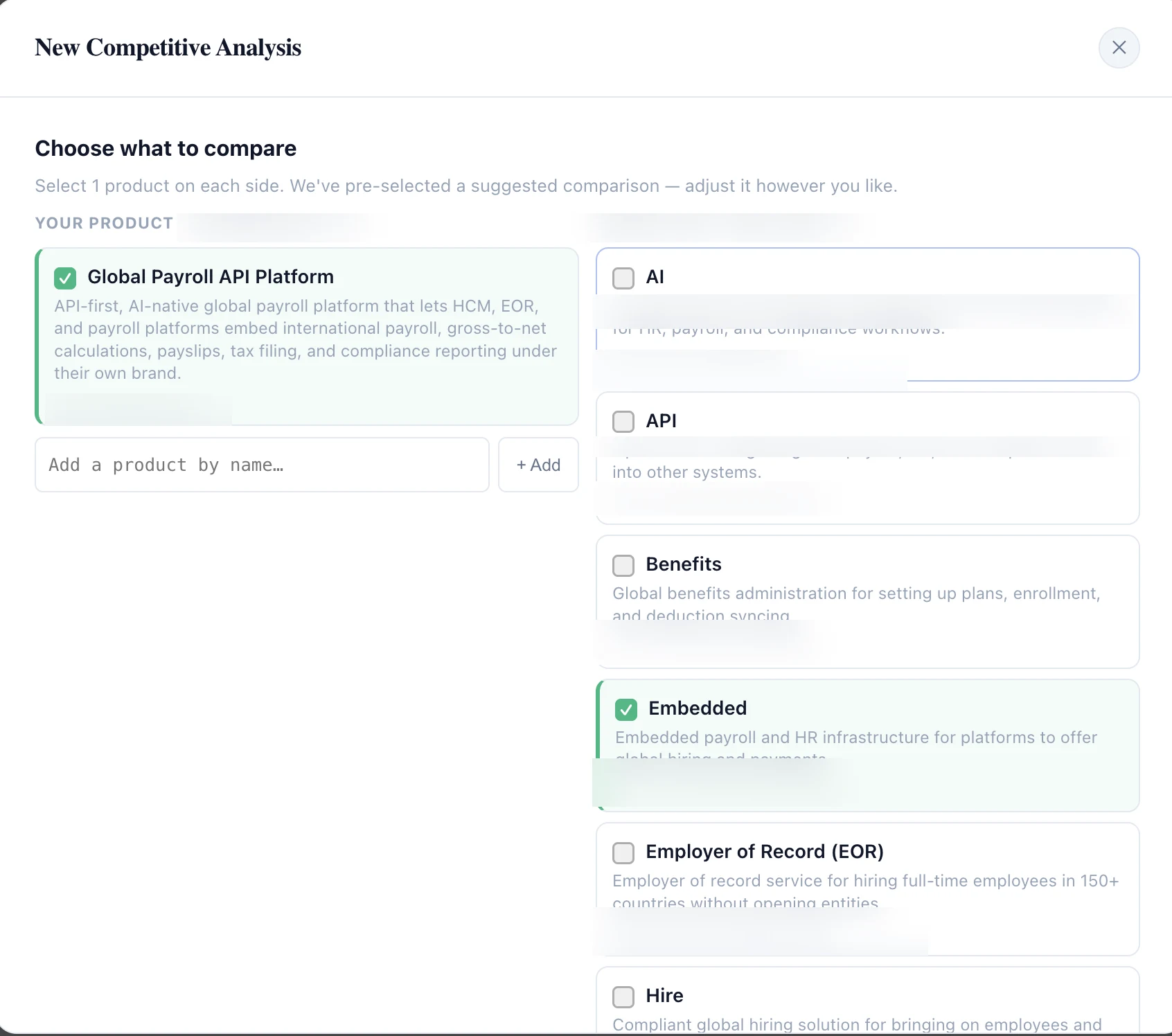
If either company offers more than one product or solution, RankAnalyze discovers all of them first and shows you both sides as a set of cards, each with its own short description and URL. You then pick exactly one product on your side and one on theirs — up to two pairings — so the comparison is always about the specific products actually competing with each other, not an average across everything a company sells.
Step 3: Run the Analysis and Review Your Results
RankAnalyze fetches both pages and runs a multi-section analysis covering scores, feature matrix, messaging, pricing, SWOT, trust signals, schema, structure, site authority and paid search where data is available. Start with the Executive Summary for the big picture, the Feature Matrix for quick wins, or download the full report to share with your team.
What a RankAnalyze Head-to-Head Report Covers
1. CGI Score, Dimension Scores and Executive Summary
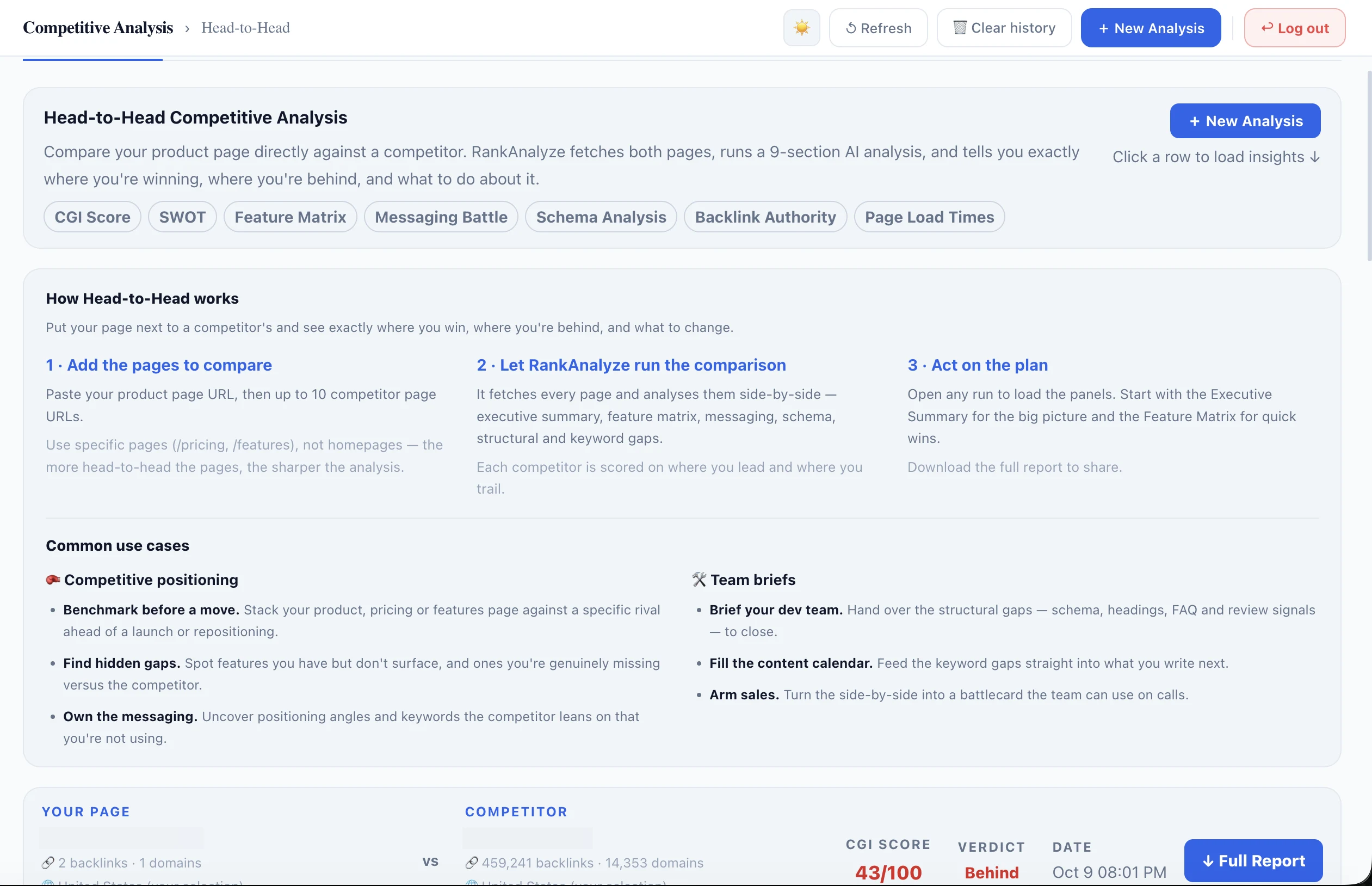
Every report opens with a single comparative CGI Score out of 100 and a plain verdict — ahead or behind — backed by individual Dimension Scores that break that number down into the categories underneath it, and a written Executive Summary that calls out the gaps most worth your attention first.
For competitor analysis, this is the card that turns a long report into a five-minute read: instead of scanning fifteen sections to decide where to focus, you get a ranked starting point, then drill into whichever dimension is dragging the score down.
2. Keyword Gap Analysis and AI Search Visibility
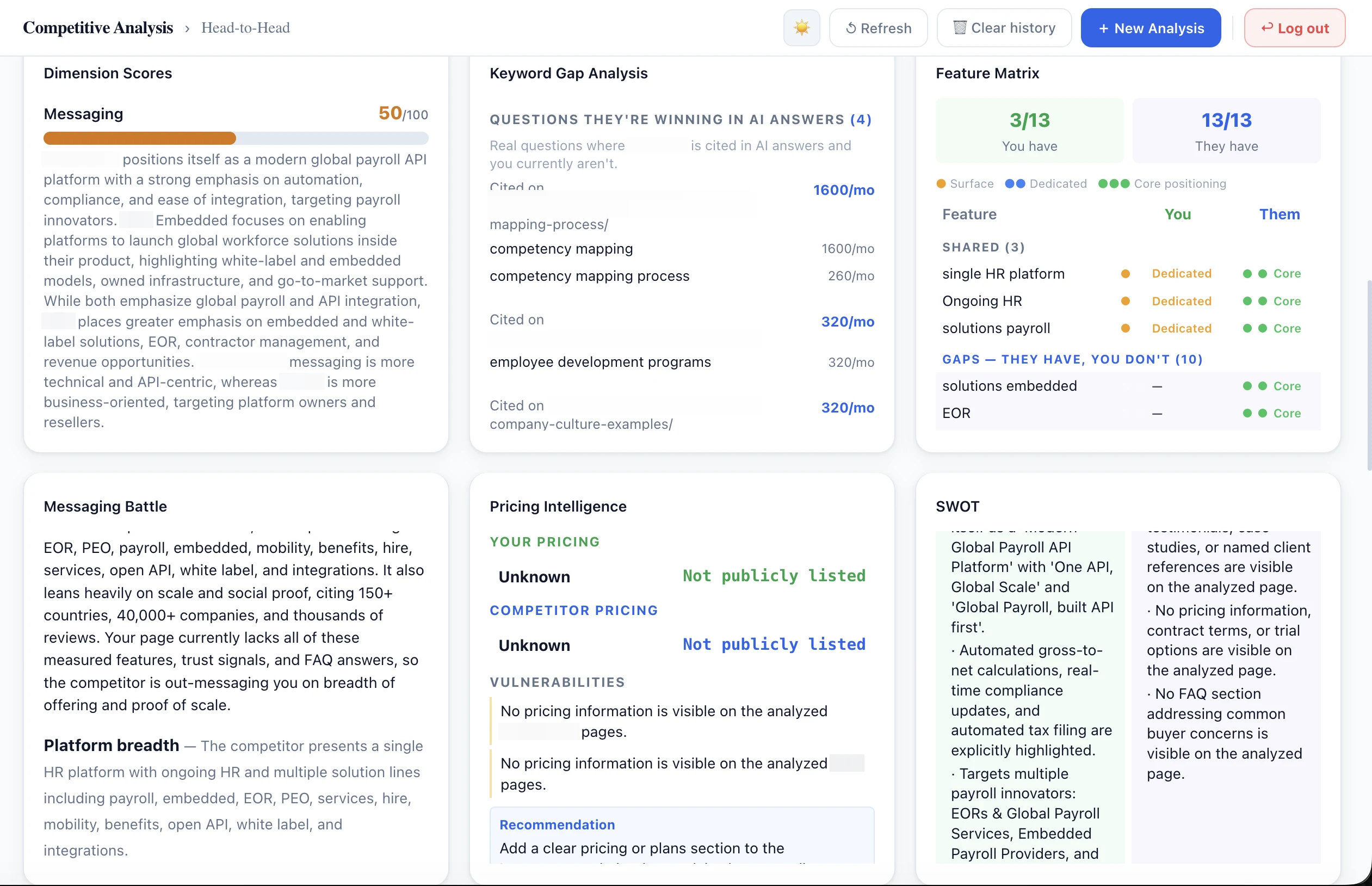
A classic keyword gap analysis — terms a competitor ranks for that you don't, with search volume, CPC and position — sits alongside something most keyword tools don't track: specific real questions where a competitor is cited in AI-generated answers and you currently aren't, each one tied to the exact page driving that citation.
This is where a competitor keyword gap analysis and an AI-visibility audit meet in one card. You get the traditional ranking gaps content teams chase, plus the newer, faster-moving gap — who gets quoted when someone asks an AI assistant the question instead of typing it into Google.
3. Feature Matrix and Capability Gaps
A Feature Matrix scores what each side's page claims on a Surface / Dedicated / Core positioning scale — Surface meaning a feature is mentioned in passing, Dedicated meaning it has its own section, Core meaning it anchors the page's whole pitch — then splits the result into shared ground and gaps.
Used as a competitor feature comparison, this tells you not just what a rival offers but how hard they're pushing it. A gap on the matrix means the competitor's page mentions something yours doesn't — a messaging gap, not confirmed proof your product lacks the capability, so it's a cue to check with your product team before changing any public claim either way.
4. Messaging Battle: Positioning and Proof
The Messaging Battle card compares how each page frames its offer, audience, benefits and proof — pulling out where a competitor is out-messaging you on breadth of claims or depth of social proof, independent of whatever the Feature Matrix shows.
This is the card to use for a competitor messaging and positioning analysis before a launch or a page rewrite: it shows you the story a rival is telling, not just the feature list, which is often the gap that actually costs conversions.
5. Pricing Intelligence
Pricing Intelligence flags concrete pricing vulnerabilities on either side — no visible pricing, an unusually gated plan page, a tier that undercuts yours — and attaches a specific recommendation to each one, not just a yes/no on whether a price is shown.
As a competitor pricing analysis, this saves the step of manually checking every plan page: you get the vulnerability and the suggested response to it in the same card, so pricing strategy conversations start from evidence instead of a hunch.
6. Competitor Profile and SWOT Analysis
The Competitor Profile quotes the rival's stated value proposition directly, alongside their audience, voice and market tier and the positioning pillars their page is built around. A full Strengths, Weaknesses, Opportunities and Threats breakdown follows, generated from what's actually visible on both pages rather than a generic template.
Together these form a self-contained competitor SWOT analysis you can drop straight into a strategy doc or a board update — grounded in quoted language and checkable evidence, not assumptions about how a rival positions itself.
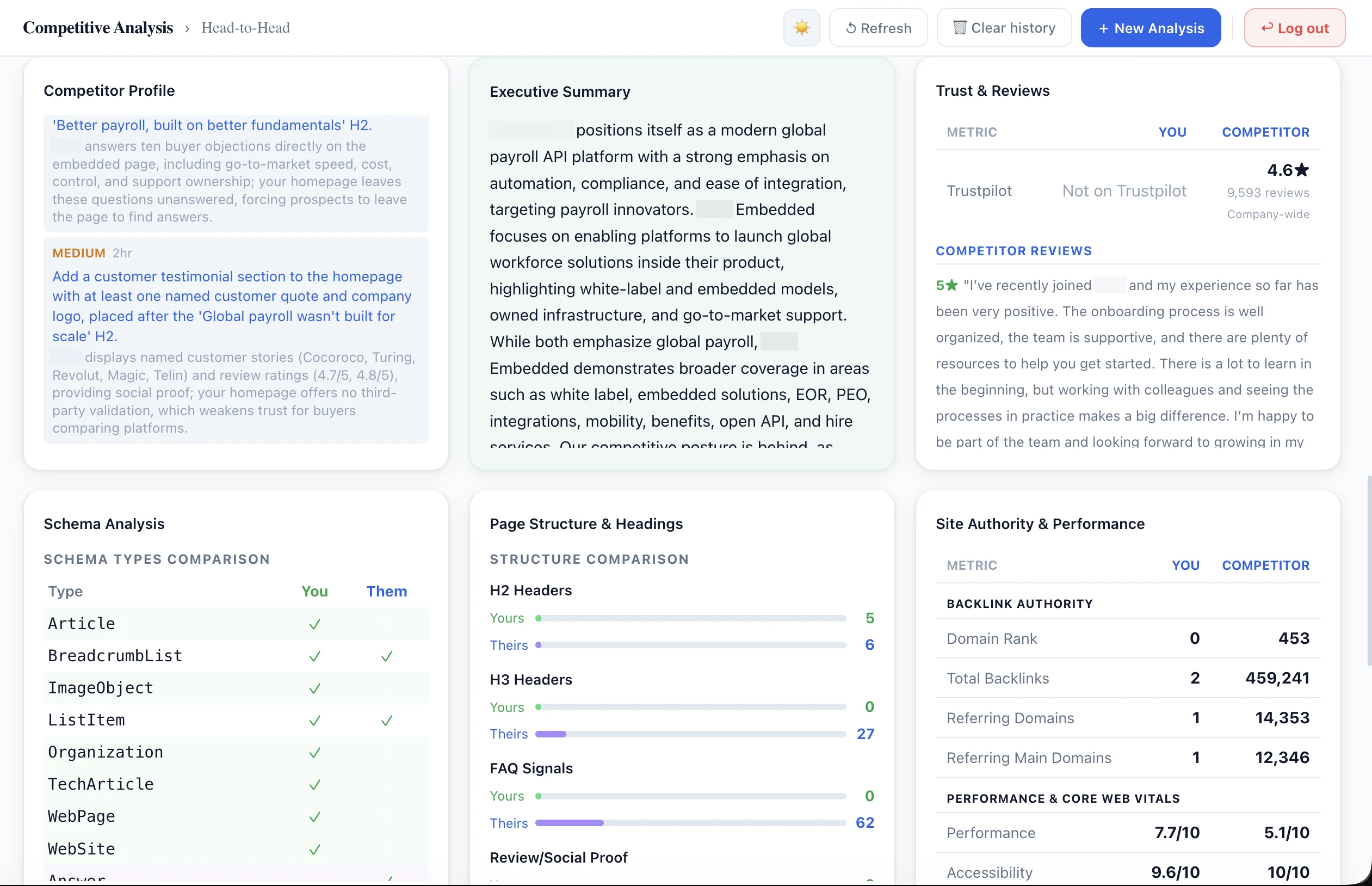
7. Trust Signals and Customer Reviews
Review platform ratings and counts are shown side by side for both products, with real review excerpts pulled in underneath — so a trust-and-reviews comparison shows not just that one side has more social proof, but what customers are actually saying that's driving it.
This card is useful for a competitor review analysis ahead of a positioning change: a rival with a lower rating but louder praise on one specific feature is a different competitive situation than one who's simply ahead on volume.
8. Schema and Website Structure Comparison
A full structured-data (schema.org) comparison shows exactly which schema types each page implements and which ones you may be missing, next to a side-by-side structure comparison — H2/H3 header counts, FAQ signals, and review or social-proof elements — bar-charted against each other.
For a technical competitor analysis, this is the card that surfaces the quieter, harder-to-eyeball differences: a competitor using FAQ or Review schema you don't, or structuring a page with twice the subheadings yours has, both of which affect how a page earns rich results and gets parsed by AI crawlers.
9. Site Authority and Performance
Domain Rank, Total Backlinks, Referring Domains and Referring Main Domains are compared directly, alongside Core Web Vitals-style Performance and Accessibility scores for both pages.
This is the backlink and technical-authority half of a competitor SEO analysis — the off-page and page-speed signals that explain part of a ranking gap the content-level cards above can't account for on their own.
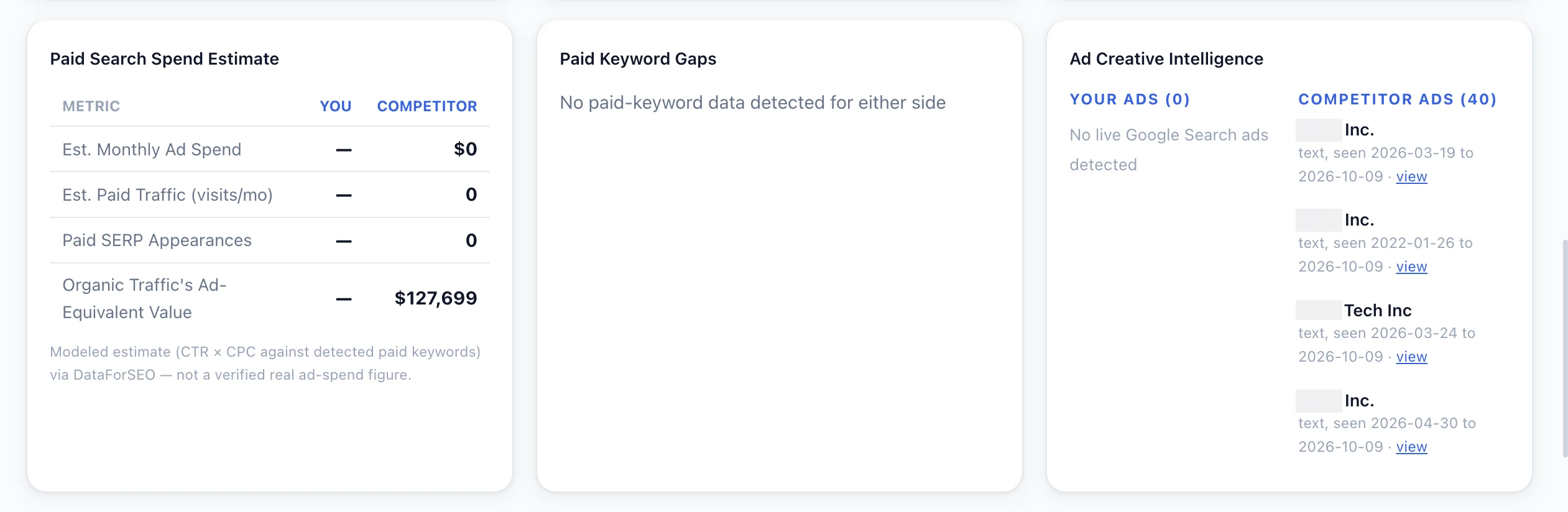
10. Paid Search and Advertising Intelligence
Where the underlying data source has coverage, this section adds an Estimated Monthly Ad Spend, Estimated Paid Traffic and Paid SERP Appearances for each side, a modeled ad-equivalent value for your own organic traffic, a Paid Keyword Gaps list, and Ad Creative Intelligence — detected ads with advertiser name, format, the date range they were observed running, and a link to view the creative.
Used as a competitor paid search analysis, it's the one place in the report that looks past organic SEO entirely to show whether a rival is also buying its way into the SERP, and with what. Spend and traffic figures here are modeled estimates, not verified ad-platform numbers, so treat them as directional evidence worth investigating further rather than audited figures.
How RankAnalyze Differs From Other Competitor Analysis Tools
Compares Exact Products, Not Just Domains
Most competitor analysis tools compare one domain against another — your homepage against theirs, or your whole site against their whole site. That works when a competitor sells one thing. It breaks down the moment they don't.
A company can offer a dozen distinct products under one domain, each with its own audience, pricing and positioning. Comparing your one product against all of that at once blurs the comparison: a "feature gap" might just mean the competitor's unrelated product has something yours doesn't, which tells you nothing useful about the product you're actually trying to position against.
RankAnalyze solves this by discovering every distinct product or solution line on both sides first, then having you pick exactly which one on your side maps to which one on theirs — up to two pairings, each run as its own independent, apples-to-apples comparison. The result is a comparison that's actually about the thing you're competing on, not an average across a company's entire catalog.
Shows Who Wins in AI Answers, Not Just Google Rankings
Classic keyword rank tracking shows who ranks on page one of Google. RankAnalyze also shows which real questions a competitor is cited for in AI-generated answers that you aren't — a visibility gap rank tracking alone doesn't capture.
Every Finding Comes With Evidence Attached
Scores and verdicts aren't black boxes. Every pricing flag, every SWOT point, every feature gap is backed by what's actually visible on the analyzed pages, with a stated recommendation attached. Where a figure is an estimate rather than a directly measured value — modeled ad spend, for instance — the report says so, rather than presenting it as a hard number.
How to Turn Competitor Analysis Into Action
Find Content and Keyword Opportunities
Use keyword and AI-citation gaps to plan content around topics and questions your competitors are already appearing for, instead of guessing what to cover next.
Identify Product and Feature Gaps
Spot features you have but don't surface on your page, and features you're genuinely missing versus a competitor — two different problems with two different fixes.
Improve Your Positioning and Messaging
Benchmark your page before a launch or repositioning, and uncover positioning angles and keywords a competitor leans on that you're not using.
Create Actionable Briefs for Your Team
Hand structural and content gaps to your dev team to close, and use the side-by-side comparison as the basis for a sales battlecard your team can build from.
Why Use a Competitor Analysis Tool Instead of Doing Everything Manually?
Manual competitor analysis works — it's what the full guide walks you through — but it means opening pricing pages, comparing feature lists by hand, checking search data in separate tools, and organizing all of it into something shareable. A tool doesn't replace the judgment calls; it replaces the hours spent assembling the raw comparison those judgment calls depend on, and leaves you with one structured report instead of a dozen open tabs.
Frequently Asked Questions
What does RankAnalyze compare in a Head-to-Head report?
Scores and an executive summary, keyword gaps and AI search visibility, feature and capability comparisons, messaging and positioning, pricing intelligence, a competitor profile and SWOT, trust and reviews, website structure and schema, site authority and performance, and paid search intelligence where data is available.
Does RankAnalyze replace manual competitor research?
No. It automates the comparison work that's otherwise manual, but deciding what matters, validating evidence, and deciding what to act on are still judgment calls a person makes — the report gives you the evidence to make them faster, not a decision made for you.
How much does a Head-to-Head report cost?
Each pairing (your product × a competitor's product) costs a set number of credits, which includes multi-page enrichment, schema comparison and the full report for that pairing. You see the exact total for what you've selected before you run it, and you're only charged after a successful run.
How many products can I compare in one analysis?
Up to two products on each side per analysis. Each pairing runs as its own independent 1:1 comparison, rather than blending multiple products into one average.
What does the CGI Score mean?
It's an overall 0–100 comparative score with a verdict — ahead or behind — and a written explanation of why. Treat it as a starting point for reading the rest of the report, not a final judgment on its own.
Why does the country I select matter?
It determines which market's Google index RankAnalyze searches when finding pages and pricing for both sides, including the pricing search. Pick the market the products actually sell into — not necessarily where you happen to be sitting.
What are pinned pages for?
Pages you pin — a pricing page, a features page, an enterprise page — are always included in the crawl, so a page you already know matters can't get missed by automatic discovery.
Can RankAnalyze compare one specific product, not a competitor's whole site?
Yes. If a competitor sells more than one product, RankAnalyze discovers all of them and lets you pick exactly which one to compare against yours, instead of averaging across everything the company sells.
Does RankAnalyze show AI search visibility, not just Google rankings?
Yes. The Keyword Gap Analysis includes real questions where a competitor is cited in AI-generated answers and you currently aren't, alongside classic keyword ranking data.
How accurate are the findings?
Every finding is backed by what's actually visible on the analyzed pages and public data sources. Figures like modeled ad spend are estimates meant as directional evidence — worth investigating further before you act on anything high-impact, not treating as audited numbers.
Start Your Competitor Analysis With RankAnalyze. Compare relevant products, uncover keyword and messaging gaps, and review the evidence behind every finding.
 RankAnalyze