How to Analyze Competitor Positioning (And Catch It the Moment It Changes)
Every competitor has a position: who they say they're for, what they claim makes them different, and how they price themselves against that claim. Most teams check this once, during a launch or a big deal review, and then never again. That's the problem. A competitor's positioning isn't fixed. They keep re-deciding it. And those changes often show up on their website.
What Is Competitor Positioning?
Competitor positioning is how a company presents itself in the market, relative to everyone else solving the same problem: who they say they're built for, the problem they claim to solve better than anyone, the price they attach to that claim, and the language they use to explain that position. It's different from a feature comparison. Two products can have nearly identical feature lists and still be positioned completely differently, one aimed at enterprise buyers who want compliance and support, the other aimed at solo operators who want speed and a low price. The feature list doesn't tell you that. The homepage, the pricing page, and the way they talk about themselves does.
How to Analyze Competitor Positioning Effectively
A useful positioning analysis answers four questions, in this order:
- Who do they say this is for? Read their homepage headline and their pricing page's plan names. "Built for enterprise teams" and "Perfect for solo founders" are two different companies wearing the same feature list.
- What do they claim makes them different? Not a feature, a claim. "The only tool that does X" or "10x faster than manual work" is a positioning bet, and it shows what the company wants buyers to notice.
- What do they charge for that claim, and how? A company positioned as "enterprise-grade" that prices low is either undercutting on purpose or hasn't committed to its own positioning yet. A company that hides its pricing may be taking a more sales-led approach, especially if buyers have to talk to sales before they can get a price.
- How has any of this changed since the last time you looked? This is the question almost nobody asks, because it requires having looked before, and having written down what you saw.
That fourth question matters most, and a one-time competitor analysis can't answer it.
Why a One-Time Snapshot Isn't Enough
A positioning analysis done once is a photograph of a moving target. Competitor positioning can change over time. A startup that launched as "the affordable alternative" might reposition as "enterprise-ready" once it lands a big customer. A company that hid its pricing behind "Talk to sales" might suddenly publish a price, because self-serve started converting better than expected. These aren't random changes. Each change can tell you something about where the competitor is heading. It may reflect a shift in their market, their costs, their product, or their own confidence. The signal is most useful when you catch it close to when it happens, not three months later during a lost-deal debrief.
Price is one of the clearest examples, and it's worth looking at on its own, because pricing changes can directly affect active deals.
How to Catch a Competitor's Price Change Before It Costs You a Deal
It usually comes up in a deal debrief. A rep says the prospect went quiet for two weeks, then came back with "we're going with [competitor], their pricing made more sense." Someone checks the competitor's site. Sure enough: new tier, lower entry price, a bundled feature that used to be an add-on. It's been live for three weeks. Nobody on the team saw it happen.
This is a common problem with manually checking the competition: the process becomes harder to maintain as the number of competitors and pages grows.
Why the manual habit always breaks
Every competitive intelligence process starts the same way: someone bookmarks five competitor pricing pages and commits to checking them weekly. It survives for two, maybe three weeks. Then a launch happens, or a busy sprint, or someone goes on leave, and the check quietly stops. Nobody decided to stop doing it, it just wasn't the most urgent thing that Tuesday, and the Tuesday after that, and it never came back.
The failure isn't discipline. It's that a scheduled human task with no visible cost for skipping it will always lose to whatever's actually on fire that week. The fix isn't "try harder to remember." It's removing the requirement to remember at all.
What's actually worth monitoring, beyond price
Pricing is the sharpest signal, but positioning shows up in a few other places worth watching alongside it:
- Pricing: tier changes, new bundling, discount language, the thing that shows up directly in a sales conversation you're about to lose.
- Feature / product pages: new capabilities that close a gap they used to have against you, the thing that turns "we have this and they don't" into a wash.
- Homepage headline and hero copy: the fastest way to see a repositioning in progress, before it shows up anywhere else on the site.
- Changelog / release notes: a useful signal of where they're investing, often before those changes appear in sales-page copy.
Homepage copy that changes constantly in small, cosmetic ways and blog posts rarely mean anything competitively, they're the noisiest, lowest-signal pages to watch. Resist the urge to monitor everything; it's exactly what makes the whole habit collapse.
What catching it early is actually worth
The value isn't just knowing. It's the gap between "I found out during a lost-deal debrief" and "I found out the same week it shipped, while there were still active deals in the pipeline where it mattered." A pricing or positioning change you catch on day two can become a talk track your sales team uses in the next call. One you catch three months later, from a lost prospect, is just an autopsy.
The teams that handle this well aren't checking more often. They've made "finding out" something that happens to them automatically, instead of something they have to remember to go looking for.
How RankAnalyze Tracks Competitor Positioning Automatically
This is exactly what Competitor Radar is built to do: you point it at the pages worth watching, per competitor, and it checks them on a schedule, so nothing depends on someone remembering.
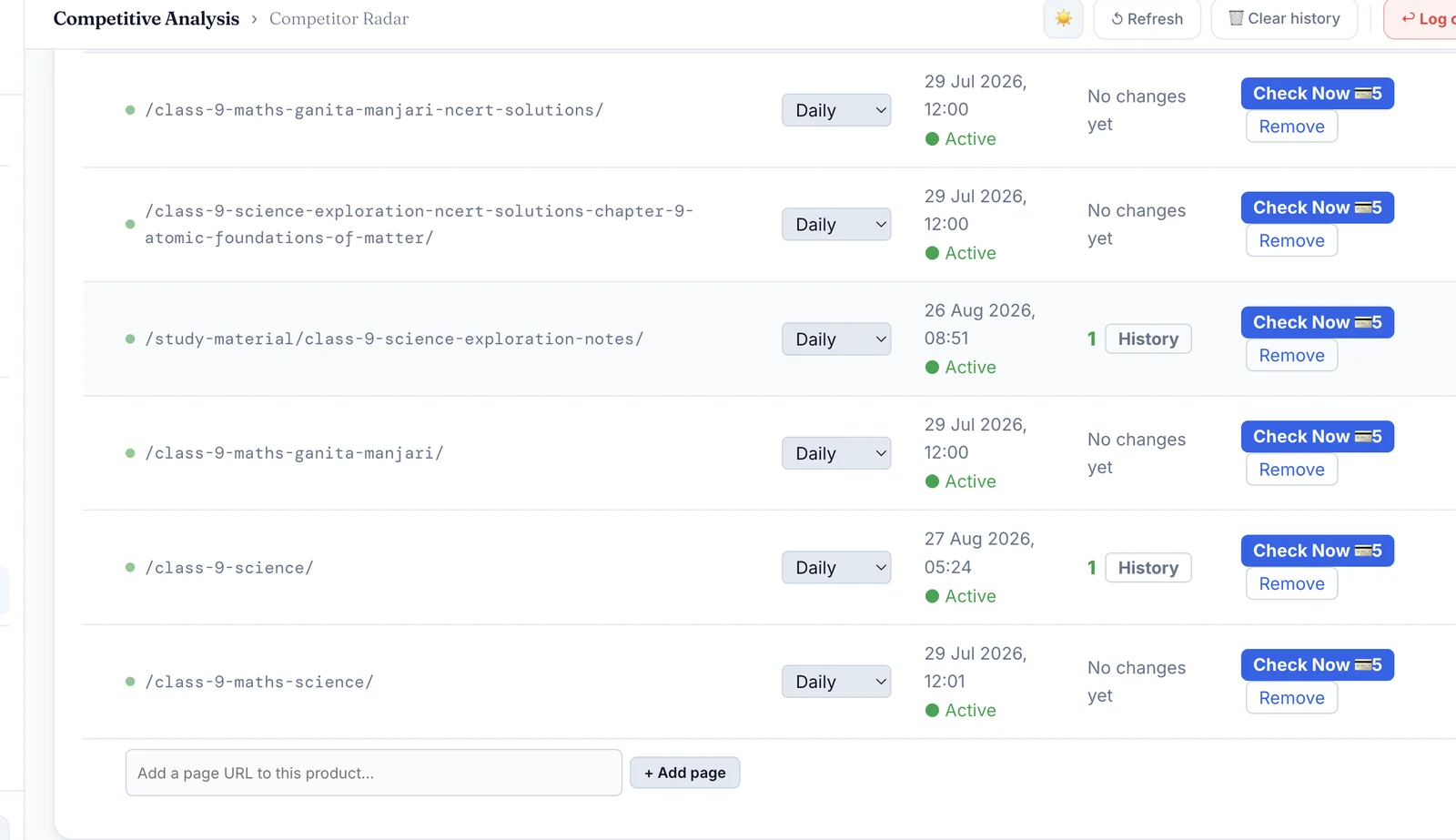
Setup is simple: add the pages worth watching for a competitor, pricing pages, homepage, key product pages, whatever actually reflects how they're positioning themselves, and set how often each one gets checked. RankAnalyze re-fetches the page on that schedule and compares it against the last version it saw.
The moment something meaningful changes, you don't just get a raw diff. You get a brief:
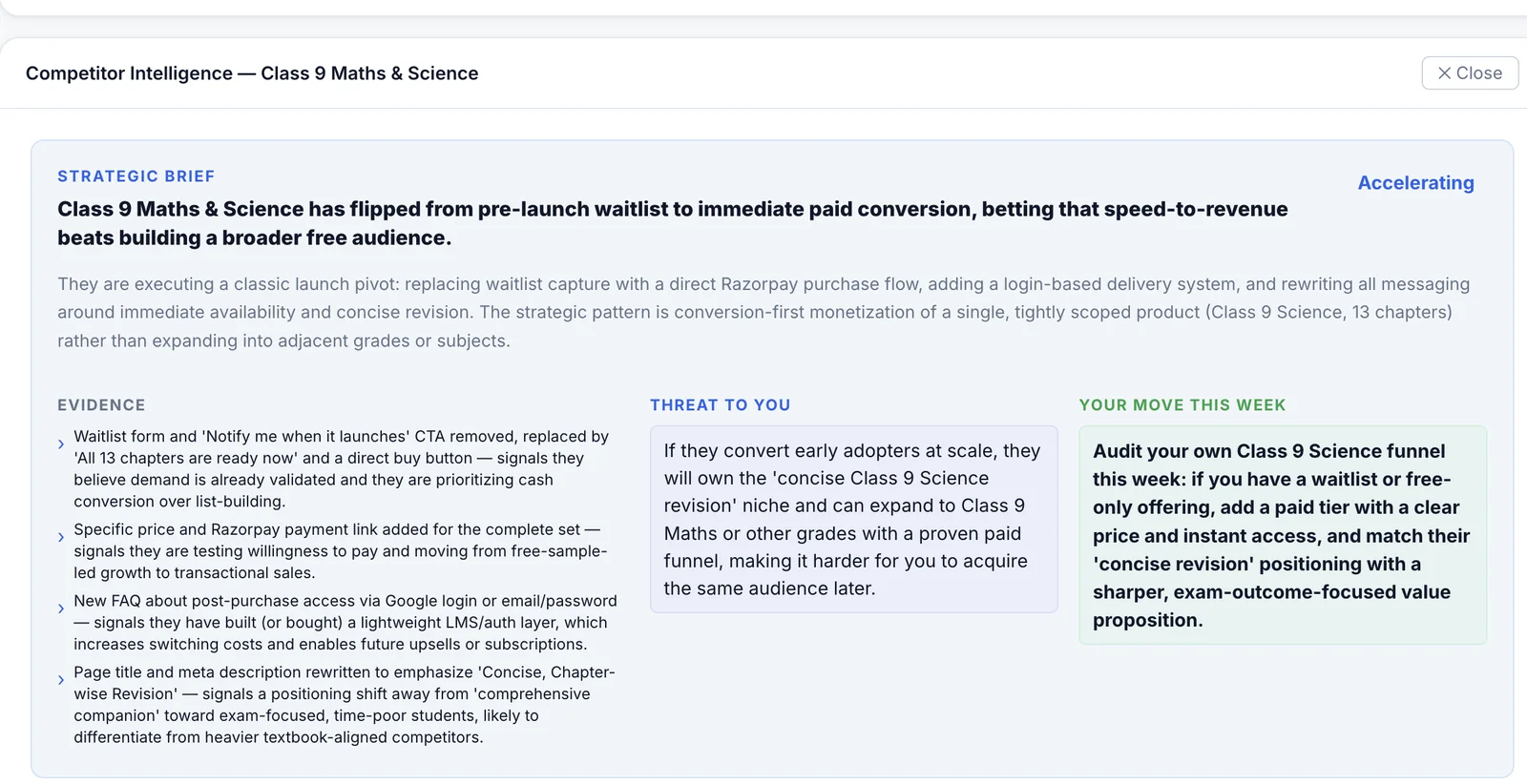
The Strategic Brief follows this structure: a plain-language headline describing what changed, evidence pulled from the page itself, what the change could mean for you, and a specific move to make that week, not a vague "keep an eye on this."
Not every change matters the same amount, so each one is labeled by category, offer, pricing, feature, messaging, removal, or positioning, so you can skim straight to the ones that matter to you:
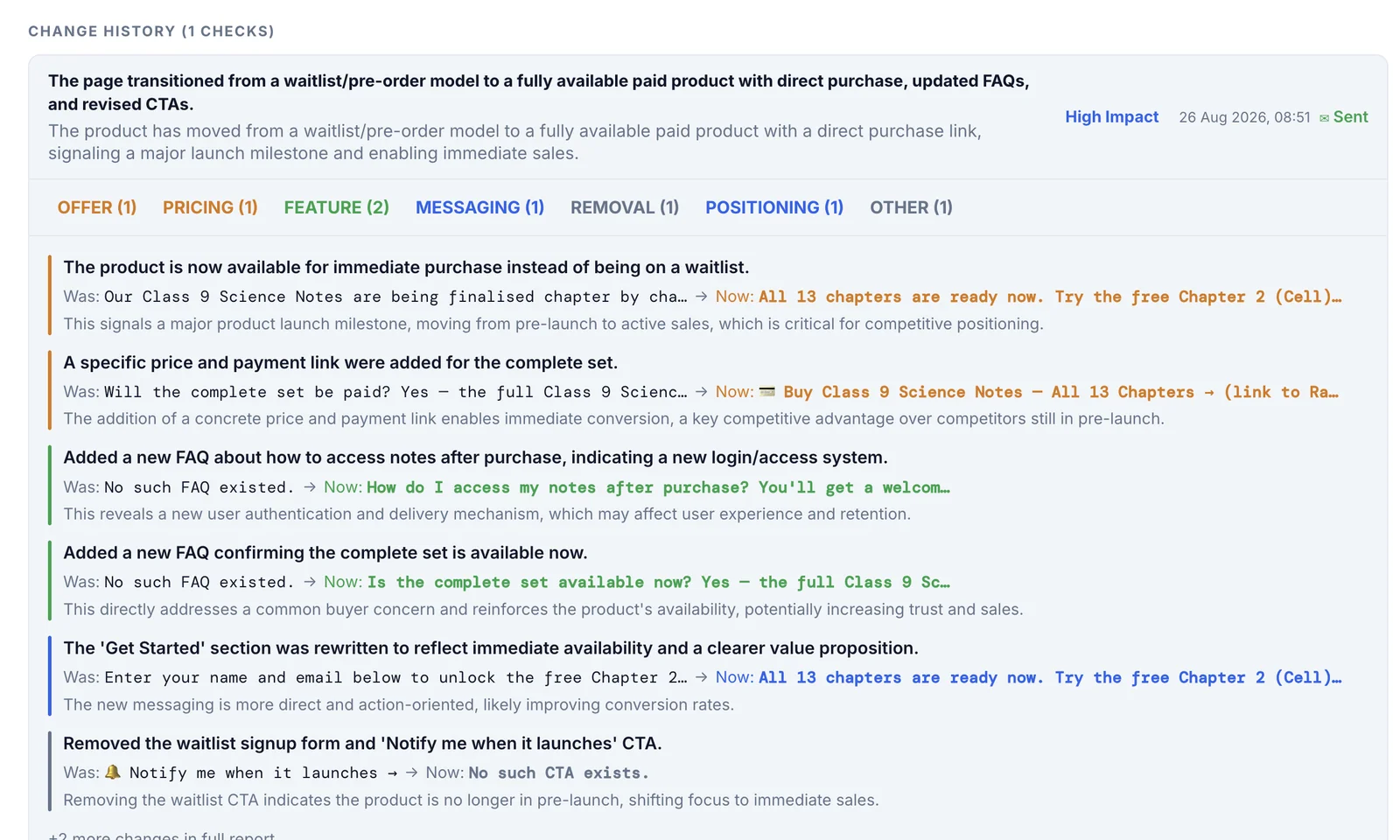
That's the part a manual weekly check can't give you: not just "this page changed," but the category it falls under, the old version next to the new version, and a plain-language note on what it could mean. A pricing page that goes from a waitlist to a live Buy button with a real price isn't just "a change." It shows the competitor has moved from pre-launch to active sales, and RankAnalyze labels it that way automatically instead of leaving you to notice.
RankAnalyze's Competitor Radar watches a competitor's pricing, homepage and product pages on the schedule you set, and turns every meaningful change into a plain-language brief: what happened, why it matters, and what to do about it this week.
A Quick Competitor Positioning Checklist
Before you consider a competitor "analyzed," make sure you've captured:
- Who they say they're for (their own words, not your assumption)
- The one claim they lead with as their differentiator
- Their current pricing and how it's presented (public, gated, or hidden)
- Whether any of the above has changed since you last checked, and when
If the answer to that last one is "I don't know," that's the gap Competitor Radar is built to close.
The Bottom Line
A competitor's positioning isn't a fixed fact you research once and file away. It's a decision they keep re-making, in their pricing, their homepage headline, or a quietly updated feature page. Catching it once, during a big deal or a launch, tells you where they stood that day. Watching it continuously tells you where they're heading, while there's still time to do something about it.
See exactly how ChatGPT, Claude, Gemini, Perplexity and Copilot describe you today.