Is AI Recommending Your Competitor Instead of You?
Why AI visibility matters is simple: some buyers now ask AI tools questions they used to ask search engines. "Best project management tool for a 10-person agency." "Alternative to X that doesn't lock me into annual billing." "Who actually has good customer support in this category." Some of these questions are typed straight into ChatGPT, Claude, Gemini or another AI assistant before they visit a vendor's website. This isn't true of every buyer, but it's common enough to be worth checking for your own business.
You don't get the same simple impression and ranking reports you get from traditional search. A buyer may never tell you that an AI answer influenced their shortlist.
Why AI visibility matters: what you can actually measure
Traditional search rankings and AI-generated answers are not the same measurement, so ranking well in Google does not automatically mean an AI system will mention your site. Google uses many signals to determine which pages to show and how to rank them, those can include relevance, links, page experience and many other signals. AI systems can use information from web pages when generating answers, but each system retrieves and uses sources differently. There is no single page format that guarantees an AI system will select or cite your site.
Rather than guessing at how any one system decides, there are four things you can actually check for your own business:
- Mention — does the AI answer name your company at all?
- Position — where does your company appear in the answer, relative to other names mentioned?
- Accuracy — does the answer describe your product correctly?
- Source — does the answer point to a specific page on your site, or just name you with nothing backing it up?
The rest of this guide walks through how to check each of these and what to do about what you find.
Why ranking #1 on Google isn't enough
A page can rank #1 on Google and still receive little visibility in an AI answer. An AI system may retrieve different sources for the same question, even when your page ranks highly in Google. The two aren't the same measurement.
One Google-specific setting
For Google Search, Search Console now includes a "Search generative AI" control (Settings > Search generative AI) for managing whether your site's links and content can be used in features such as AI Overviews and AI Mode. Google rolled this out to all websites worldwide on August 31, 2026.
The check: a quick manual test
You don't need a tool to get a first read on this. Open ChatGPT, Claude, Gemini, Perplexity and Copilot in five tabs and ask each one the same question, phrased the way a buyer would actually ask it, not the way you'd phrase it internally. Use the same prompt in each tool, and repeat it across several relevant questions, not just one:
- "What's the best [your category] for [your type of customer]?"
- "[Your category] alternatives to [your biggest competitor]"
- "Who has the best [the thing you're actually known for]?"
Because AI responses can change based on the wording of the question, when you ask, and changes on the model's side, treat each answer as a snapshot, not a final score. One response isn't enough to prove a trend, that's what the "check regularly" section further down is for.
Then try a competitor's name in the same question. If they show up and you don't, that's a signal worth investigating. Do this for five or six real questions, not just one, a single missed mention could be random. A pattern across several questions tells you something worth fixing.
How to interpret what you find
Read each answer against the four things from earlier:
- Are you named at all? This is the first thing to check, but it doesn't tell you whether the answer describes your company accurately or points readers to your site.
- Where do you appear? Check whether the answer places you among the main recommendations or mentions you only after several alternatives.
- Is what's said about you accurate? This is the one people skip entirely. If an AI answer gets your pricing wrong, attributes a feature to you that you don't have, or describes a feature you deprecated a year ago, it can affect a buyer's understanding of your product before they ever visit your site.
- Are you cited, or just mentioned? In this guide, "citation" means a source link or reference that points the reader to a specific page used to support the answer. A citation gives the reader a way to inspect the source behind the claim. A mention does not necessarily do that.
Not every AI response includes web sources, so treat the source check as something to record when sources or links are available, not something every answer will have.
If you find you're mentioned but never cited, named, but the model isn't pointing at anything you actually published, that doesn't necessarily mean there's a problem with your content. It can come from how the system retrieves and selects sources. Retrieval, which sources are available, freshness, and how the question is worded can all play a role, not just how your content is structured.
The answer isn't always to publish more content. In many cases, improving the pages you already have may be more useful than adding another generic article.
Where AI Actually Gets Its Information
Before the "what to improve" list, it helps to know where an AI answer actually comes from. The systems don't publish their exact logic, and it can change without notice. For a company trying to understand why AI mentions it, three channels are especially useful to think about.
Training data. Models are trained on a snapshot of content gathered up to a cutoff date, public web pages, licensed content, and other sources. Content published after that cutoff isn't part of that training snapshot. A model can still learn about newer information through later training or, in systems that use retrieval, by fetching current information when you ask. This is one reason an AI answer can describe pricing or a feature you've since changed, the training data simply predates the update.
Live retrieval. Some AI products can also retrieve current information at the moment you ask, through their own crawler or by drawing on a search index, rather than relying only on their training data. This is the channel most directly affected by whether your page can be crawled and indexed at all, and by how clearly it answers the question once it's found.
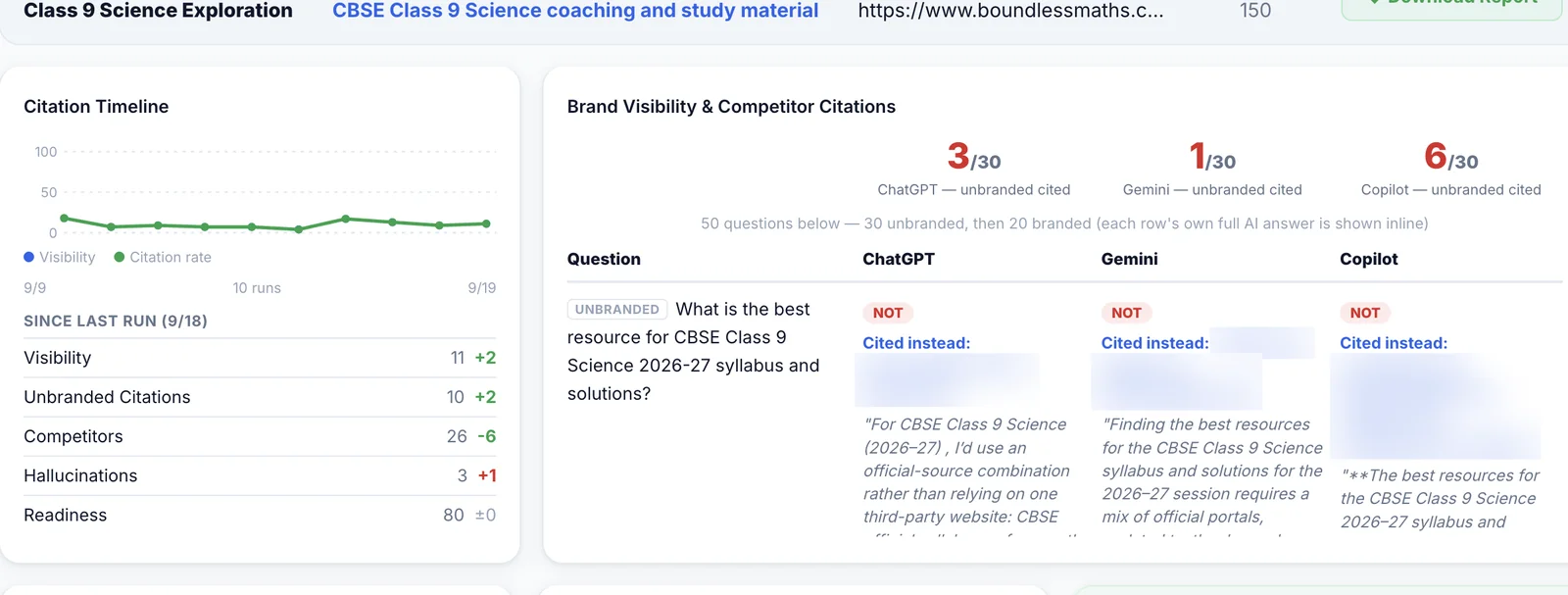
Here's how RankAnalyze's Geo Scan actually does this: it asks the same buyer-style question across ChatGPT, Gemini and Copilot, then records exactly what each one cited instead of the site being checked. This is a real scan report. Competitor names are blurred.
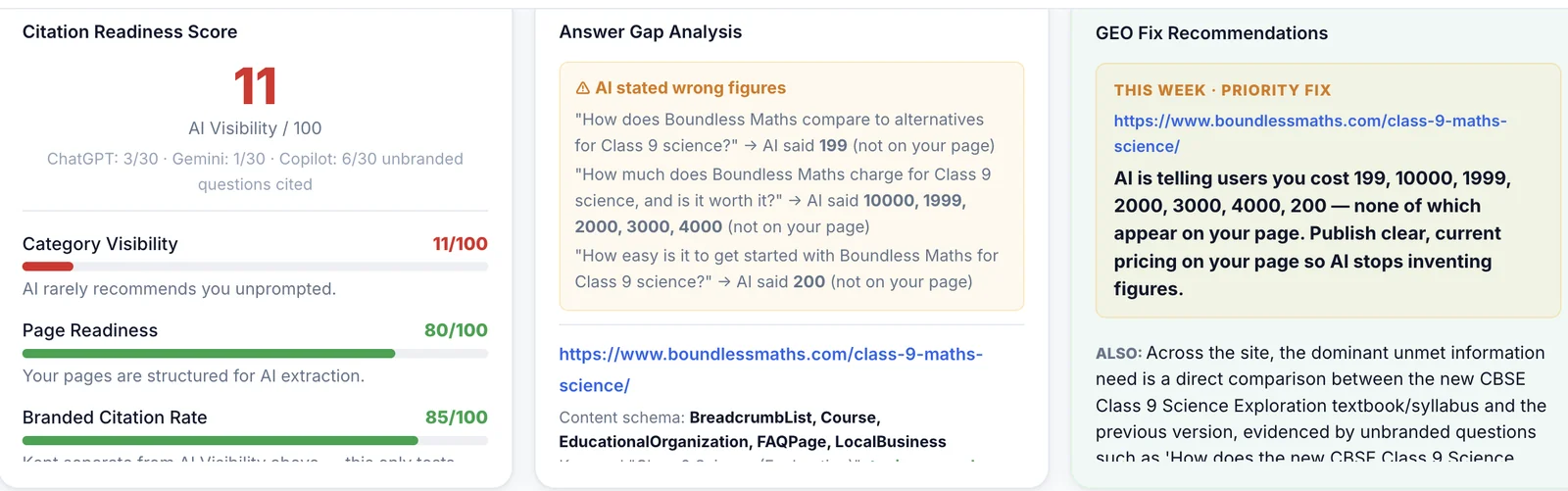
The scan turns that into a single readiness score, flags the specific facts an AI got wrong, and hands back a prioritized fix for the week.
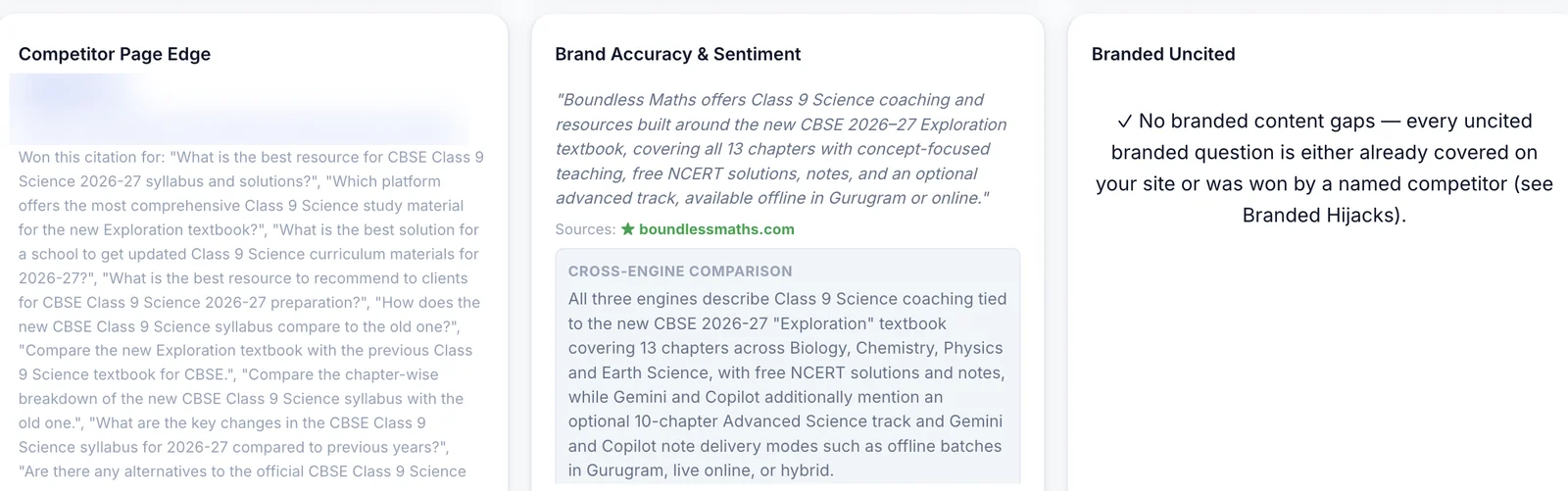
It also shows which competitor page is winning a citation and why, alongside a check on whether the AI's own description of the brand is accurate.
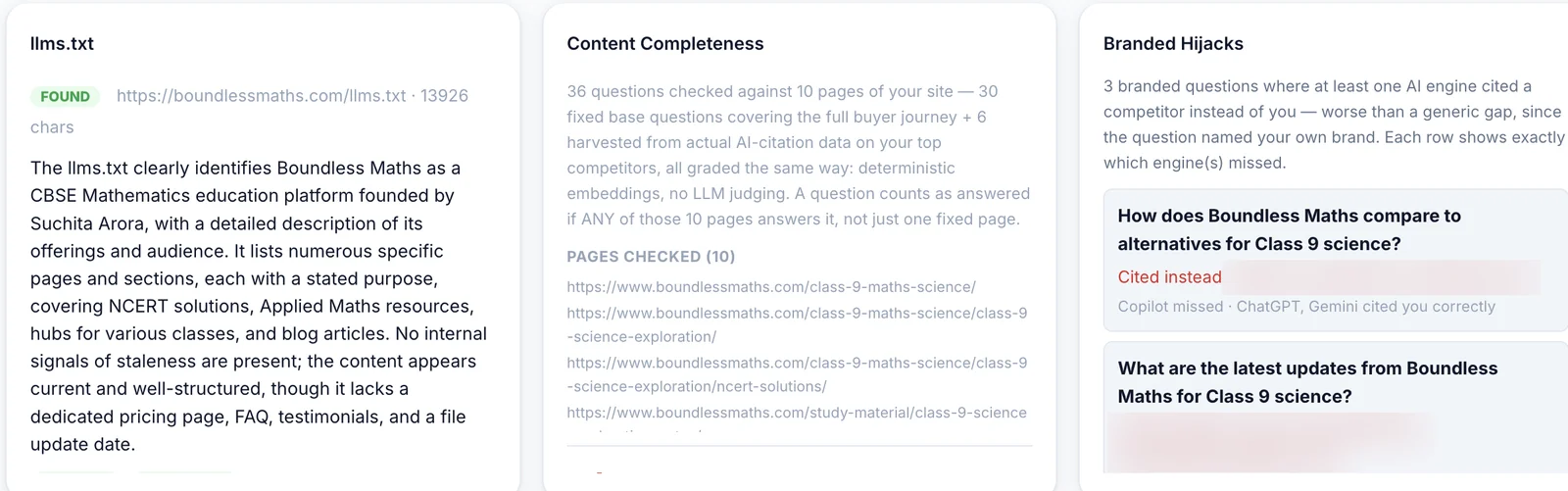
And it separates out the cases that matter most: a branded question, where a buyer already searched by name, that still got answered with a competitor's page instead.
Third-party licensing and mentions. Some AI companies also have direct agreements that give them access to specific platforms' content. What's said about you there can carry weight in an answer, separate from anything on your own site. More broadly, review sites, comparison pages and industry publications can feed into both training data and live retrieval. That's a real reason to keep facts about your company consistent on third-party sites, not just your own.
There's a fourth channel worth a mention, even though it doesn't affect whether AI mentions you to someone else: a user can upload a file or connect a tool directly to an AI system through an API or a protocol like MCP. That's the system pulling in one person's own data on request, not building a general picture of your brand, so it's a different concern from the one this guide is about.
None of this tells you exactly how any one system will handle a specific question about you. But it's why the fixes below keep coming back to the same few things: staying crawlable, staying accurate on pages you don't control, and not assuming one clean-up pass stays current forever.
What you can improve
1. Answer the main question clearly near the top
Putting the answer near the top makes the page easier for readers, and potentially easier for search and AI systems, to interpret.
2. Be specific, not vague
Specific claims are easier to verify than vague claims such as "many customers see great results."
3. Make sure facts about you are consistent everywhere, not just on your own site
Independent sources can provide additional information about your company. Reviews, comparison sites, industry publications and other third-party pages may be used alongside information from your own website. The important point isn't to repeat the same claim everywhere, it's to make sure important facts about your company are accurate and consistent across reputable sources.
4. Structure comparisons explicitly
If a competitor or third-party site has a useful comparison page and you don't, that page may be the source available for comparison-related queries.
5. Keep claims current
AI systems may use information that is older than the version currently shown on your site. Keeping pricing, features and comparisons current reduces the chance that outdated information is picked up or repeated and can give buyers the wrong impression.
6. Check regularly, not once
A one-time check tells you where you stood on the day you checked. Regular checks help you spot when competitors begin appearing more often for questions that matter to your business.
RankAnalyze's Geo Scan checks how your site appears across AI queries, including whether your pages are being surfaced as sources and which competitors appear alongside them, and hands back prioritized fixes based on what it finds.
The manual check above is worth doing today, once, so you know where you stand right now. Whether it's worth doing every week by hand is a different question. If you need to check many queries regularly, a scheduled scan can save time.
A quick checklist
- Have you asked ChatGPT, Claude, Gemini, Perplexity and Copilot the same buyer-style question, more than once, and read all the answers?
- Are you named at all?
- Where do you appear, one of the main recommendations, or a later mention?
- Is what's said about you actually accurate: pricing, features, positioning?
- Did you try a competitor's name in the same question to see if they show up instead?
- Are you cited with a link or source, or simply mentioned?
- Does your pricing or comparison page answer the main question clearly near the top?
- Is there a direct comparison page for the "X vs Y" questions buyers are actually asking?
- Is anything you're relying on being cited for now out of date?
Frequently Asked Questions
Why would ChatGPT recommend a competitor instead of me?
One possible reason is that the competitor has information that's easier for the system to find and use for that particular question. Other factors can also affect which sources appear. AI systems can also make mistakes, so being omitted doesn't necessarily mean your content is worse. An AI answer isn't a reliable measure of your product's overall quality, it reflects the information and sources available to the system for that particular question.
Does ranking #1 on Google mean AI assistants will mention me too?
No. Ranking highly on Google does not guarantee that an AI assistant will mention your company. AI products can retrieve and present information differently, depending on the product and the question.
What's the difference between being mentioned by AI and being cited by it?
A citation gives the reader a source to inspect. A mention may simply identify the company without pointing to supporting information. Being mentioned without a source link is worth tracking, but it doesn't tell you why the system selected you.
How often should I re-run this check?
A one-time check only tells you where you stood on the day you ran it. AI answers shift as models update and as your content, and your competitors', changes. Regular checks help you spot changes in which companies and pages appear for important questions.
Can I influence which page an AI system cites?
Not directly. You can, however, make your pages clearer and easier to use as sources. Good practices include answering the main question clearly near the top, backing claims with specific numbers instead of vague statements, building comparison pages for the questions buyers actually ask, and keeping pricing and feature claims current.
Does AI have a knowledge cutoff, and does that affect what it says about my company?
Yes, for the training-data part of how these systems work. A model's training data is gathered up to a cutoff date. A pricing change or a new feature you shipped afterward won't be part of that training snapshot. Some AI products can still find newer information through live retrieval, which is one reason two different AI tools can describe your company differently even when asked the same question.
Do I need a tool to check this, or can I do it manually?
You can get a real first read manually: open ChatGPT, Claude, Gemini, Perplexity and Copilot and ask each the same buyer-style question. A tool matters once you want this checked across many questions and on a schedule, rather than whenever you remember to go look.
Will working on AI visibility hurt my regular SEO?
These practices don't require you to abandon traditional SEO. Clear answers, accurate information and useful comparisons can also make a page better for human readers and search engines, although AI visibility and Google rankings are not the same thing.
See exactly how ChatGPT, Claude, Gemini, Perplexity and Copilot describe you today.