Query Fan-Out: What It Is and How Google's AI Search Uses It
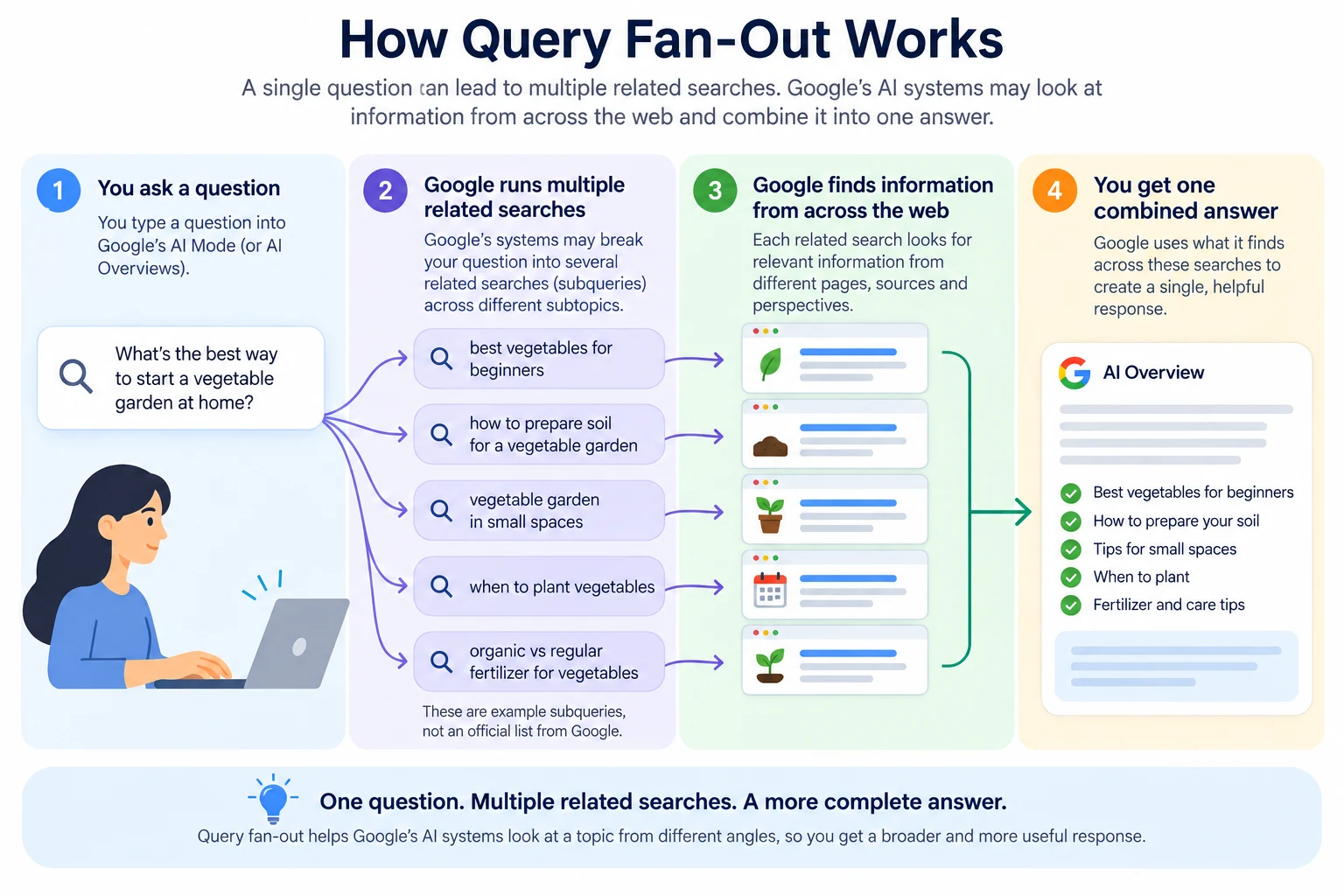
Type a question into Google's AI Mode and you get one answer. Google says its AI systems may run several related searches across different subtopics and data sources, then use what they find to develop a response. That process has a name in the SEO industry: query fan-out.
What Is Query Fan-Out?
Google's own Search Central documentation describes it directly: "Both AI Overviews and AI Mode may use a 'query fan-out' technique -- issuing multiple related searches across subtopics and data sources -- to develop a response." Google puts the phrase in quotes there, which is a signal worth noticing: "query fan-out" started as shorthand used by SEO practitioners to describe the behavior, and Google has since adopted the same term in its own documentation, even though it isn't the original source of the phrase.
The basic idea: a single, narrow search often can't gather everything needed to answer an open-ended question well. So instead of running your exact query once, the system can run several related searches, gather results from each, and then generate one answer that draws on all of them.
Why One Query Becomes Several
A short example makes this concrete. Someone types a broad question like "best running shoes for a first marathon." A traditional search would return results for that query. A system using query fan-out can instead run several related searches behind the scenes: narrower versions ("running shoes for marathon beginners"), comparisons ("cushioned vs. minimalist shoes for long distance"), and follow-up angles someone researching this topic would likely want next ("how to break in new running shoes before a race"). The answer you see combines information gathered across all of those searches, not just the one you typed.
Different people describe the range of subquery types differently, and there's no single confirmed list from Google itself. In general terms, the related searches tend to include things like: rephrased versions of your question, narrower or broader versions of the same topic, comparisons between options, and questions someone would naturally ask next. The exact mechanics aren't fully public, so treat any specific, numbered breakdown you see elsewhere as one researcher's interpretation, not a confirmed Google specification.
How This Is Different From a Regular Search
In a traditional Google search, you enter one query and Google returns a set of results for it. With query fan-out, a single page might be used in an AI answer if it provides relevant information for one of several related searches the system ran, not necessarily the exact phrase the person typed.
That changes what "matching the search" means. Ranking for one specific keyword phrase doesn't guarantee your page ends up in the mix, and a page that never ranked well for the exact original phrase can still get used if it answers one of the related searches well.
What This Means for Content, Realistically
There's no confirmed formula for getting a page pulled into a specific subquery, and no tool, including this one, can promise it. What's actually controllable is how thoroughly and clearly a page covers a topic. A few practical implications are worth considering, without treating any of them as ranking guarantees:
- Covering a topic's likely follow-up questions on the same page, or a well-linked set of pages, gives a system more of the related searches a chance to match something you've actually published.
- Clear subheadings that name a specific angle of the topic (a comparison, a narrower use case, a common follow-up question) make it easier for a system to identify which part of your page answers which subquery.
- Ranking well for a page's main keyword is still worth doing, but it isn't the same test as being useful for the related searches a fan-out process might run. A page can be strong on one and weak on the other.
- This overlaps with why long-tail keyword coverage matters (see the Long-Tail Keywords guide) -- many of the "related searches" in a fan-out process look like the same narrower, more specific phrases that guide covers from a traditional-search angle.
Query Fan-Out and Keyword Research
This doesn't replace keyword research, it adds a reason to take topic coverage seriously rather than optimizing for one exact phrase. The full process for finding and organizing keywords, including the related searches and follow-up questions worth covering, is in the SEO Keyword Research guide. What query fan-out adds to that process: when you're deciding whether a related phrase deserves its own coverage on a page, remember that an AI system may search for that exact related phrasing on its own, separately from whatever the person originally typed.
RankAnalyze's Ranking Audit shows topic coverage and white space opportunities against what's actually ranking for a keyword right now -- useful for spotting related angles a page may be missing.
A Quick Checklist
- Does your page answer the obvious follow-up questions someone researching this topic would have, not just the main question?
- Are related angles (comparisons, narrower use cases, common follow-ups) broken out under their own subheadings, not buried in one paragraph?
- Have you checked what's currently ranking and being cited for the related searches around your topic, not just your main keyword?
- Are you treating "ranks for the main keyword" and "covers the related searches well" as two different things to check, not one?
Frequently Asked Questions
What is query fan-out in simple terms?
It's when an AI search system runs several related searches around one question and combines what it finds into a single answer.
Did Google invent the term "query fan-out"?
No. It started as shorthand used by SEO practitioners to describe the behavior. Google has since used the exact phrase, in quotes, in its own Search Central documentation, but it isn't the original source of the term.
Does query fan-out only happen in Google's AI Mode?
Google's own documentation says both AI Overviews and AI Mode may use this technique. Other AI search tools may use similar approaches, but their internal retrieval methods are not necessarily the same.
How do I optimize a page specifically for query fan-out?
There's no confirmed formula, and no tool can guarantee a specific result. What helps is covering a topic's likely follow-up questions and related angles clearly, with subheadings that make each angle easy to identify, rather than optimizing narrowly for one exact keyword phrase.
Does ranking well for my main keyword still matter?
Yes, traditional ranking hasn't stopped mattering. Query fan-out adds a separate consideration on top of it: whether your page also answers the related searches a system might run, which isn't guaranteed just because you rank well for the main phrase.
See exactly how ChatGPT, Claude, Gemini, Perplexity and Copilot describe you today.