Long-Tail Keywords for SEO: What They Are and How to Find Them
A broad keyword like "running shoes" gets searched a lot, but many sites are competing for it. Big retailers and established sites already rank for it, and the search itself doesn't tell you much about what the person actually wants. A long-tail keyword like "best running shoes for flat feet marathon training" is much more specific. It may have fewer searches than "running shoes," and it may be easier to compete for, but you still need to check the results before assuming it will be easy to rank for.
What Makes a Keyword "Long-Tail"
There is no single industry-wide cutoff for what counts as a long-tail keyword. A long-tail keyword generally refers to a search query with relatively low search demand compared with broader keywords about the same topic. It's often more specific, but word count alone does not define it.
That last point is worth its own callout, because it's the most commonly misunderstood part of the term:
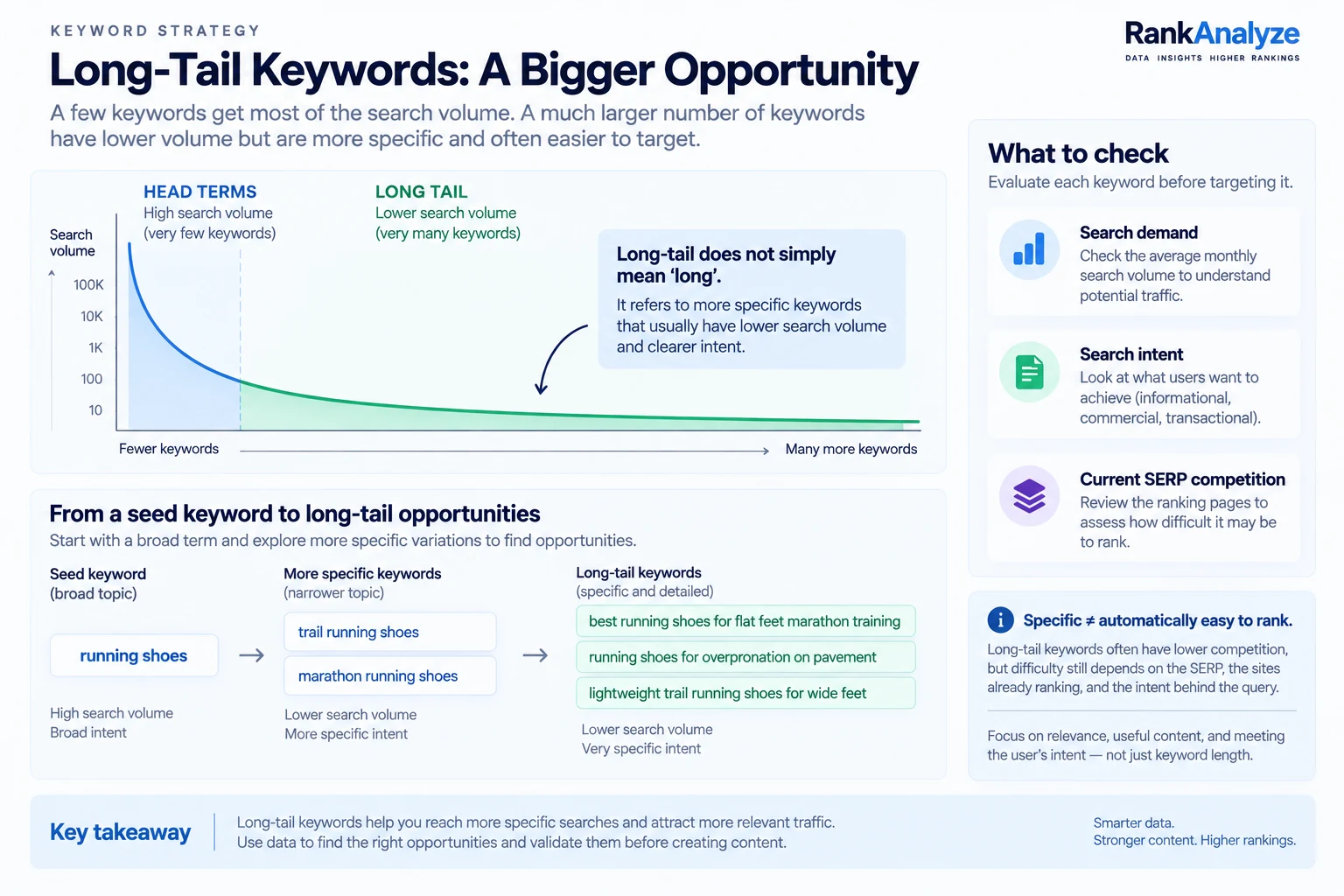
Long-tail does not simply mean "long"
A five-word keyword is not automatically long-tail. A shorter keyword can also fall into the long tail if it has very low search demand compared with broader terms in the same topic. The term comes from the shape of the search-demand curve, not a word-count rule.
The name comes from the shape of this search-demand curve: a small number of keywords get very large numbers of searches, while a much larger number get relatively few searches each. Those lower-volume queries make up the "long tail."
Why People Target Long-Tail Keywords for SEO
There are a few practical reasons to target them:
- Often lower competition. Specific queries may have fewer competing pages, although this varies by topic. A long-tail keyword can still be hard to rank for when many strong pages already target the same search -- it's not automatically easy.
- More specific intent. The extra words in a long-tail query usually narrow down what the person wants, which makes it easier to write a page that actually matches what they're looking for.
- There are a very large number of low-volume search queries out there. A site can get traffic from many smaller searches instead of depending on one popular keyword.
Where to Actually Find Long-Tail Keywords
The full keyword research process -- seed keywords, expanding the list, checking intent, grouping into topics -- is covered in the SEO Keyword Research guide. These are the sources worth checking specifically for long-tail variations once you already have a seed term:
- Autocomplete. Start typing your seed keyword into Google and look at the suggestions. Google's own explanation of autocomplete predictions says these can reflect searches people have made, along with factors such as location, language, trends and previous searches.
- People Also Ask and related searches. Look at the questions and related searches that appear around your topic. They can reveal related questions and different ways people search for the same subject.
- Forums and communities (Reddit threads, niche forums, Q&A sites) in your category. People ask questions there in their own words, which tends to closely match how they'd phrase a search.
- Your own support tickets, sales calls and customer questions. Repeated questions can reveal topics worth researching. Check whether people are actually searching for those questions before treating them as SEO opportunities -- a repeated support question can just as easily point to a confusing product or a documentation gap as to a real search demand.
- A keyword tool's "questions" or "phrase match" filters can help you find variations faster than checking the sources above one at a time. Use the reported search volume as an estimate, not an exact count -- estimates vary between tools.
A Worked Example
Take the seed keyword "running shoes" again. Broad keyword: "running shoes" -- huge volume, huge competition, vague intent. Some narrower searches might be "trail running shoes" or "marathon running shoes." More specific examples include "best running shoes for flat feet marathon training," "running shoes for overpronation on pavement," and "lightweight trail running shoes for wide feet" -- these are the long-tail end of the list.
These phrases are much narrower than "running shoes," and they may have far fewer searches -- the actual search volume needs to be checked in a keyword tool. But someone searching one of them has given Google (or an AI assistant) more information about what they want, which makes the search intent easier to interpret. A page that directly answers the query can be a better match for that intent -- whether it actually ranks still depends on the competition, the quality of the page, the site's overall strength, and other factors.
What Not to Do
- Chasing volume without checking intent. A long-tail phrase with decent search volume but mismatched intent (informational searches when you're selling something, or the reverse) may bring visitors who are not looking for what your page offers, even if you rank for it.
- Writing unnaturally to fit the exact phrase. A page should read like it was written for a person, with the long-tail phrase and its natural variations worked in where they fit -- not repeated verbatim for the sake of matching the search term.
- Assuming every long-tail keyword needs its own page. One page can rank for several closely related queries. Before creating a separate page for a long-tail keyword, check whether it represents a distinct search intent or can be answered well on a page you already have.
Long-Tail Keywords and AI Search
People often ask AI assistants questions in fuller, more natural language than they use in traditional keyword searches. Those questions can be useful when researching topics and the language people use to describe what they want. But that does not mean long-tail keywords have a special ranking advantage in AI search, or that writing in question form guarantees visibility there.
RankAnalyze's Keyword Gap Analysis can show long-tail terms that competitors rank for while your site does not.
A Quick Long-Tail Keyword Checklist
- Does the keyword clearly show what the searcher wants, not just a topic?
- Have you checked Autocomplete and People Also Ask for natural phrasings, not just guessed variations?
- Have you checked what your own customers actually ask, in their own words, and whether people are actually searching for that?
- Are you covering closely related searches on the same page when they share the same intent, instead of building a separate page for each variation?
- Does the intent behind the phrase actually match what your page offers?
- Does the page read naturally, or does it feel like it's repeating the exact phrase for its own sake?
Frequently Asked Questions
How many words make a keyword "long-tail"?
There is no single industry-wide cutoff. A long-tail keyword generally refers to a search query with relatively low search demand compared with broader keywords about the same topic. It's often more specific, but word count alone does not define it.
Are long-tail keywords always easier to rank for?
Not automatically. Lower competition is common for long-tail phrases because fewer pages target them specifically, but a long-tail keyword can still be hard to rank for when many strong pages already target the same search. Check what's already ranking for a phrase before assuming it will be easy.
Should I build a separate page for every long-tail keyword?
Not necessarily. First check whether the keyword has a different search intent from pages you already have. If several closely related queries can be answered well on one page, there is usually no reason to create a separate page for each variation.
Do long-tail keywords matter for AI search, not just Google?
People often ask AI assistants questions in fuller, more natural language than they use in traditional keyword searches. That makes conversational questions useful when researching topics, but it does not mean long-tail keywords have a special ranking advantage in AI search.
What's the difference between long-tail keywords and the keyword research process in general?
Keyword research is the full process: finding seed keywords, expanding the list, checking intent, and turning it into a content plan (see the SEO Keyword Research guide). Long-tail keywords are a specific category within that process -- the lower-demand, often more specific end of the list, not a separate method.
See exactly how ChatGPT, Claude, Gemini, Perplexity and Copilot describe you today.