Intent-Based Search Optimization: The Complete Guide
Search intent is the reason behind a query. It's what the searcher actually wants, not just the words they typed. Two people can type the exact same phrase and want different things. "Best running shoes" from someone comparing prices is a different intent than the same phrase typed by someone who just wants a quick top-10 list to skim.
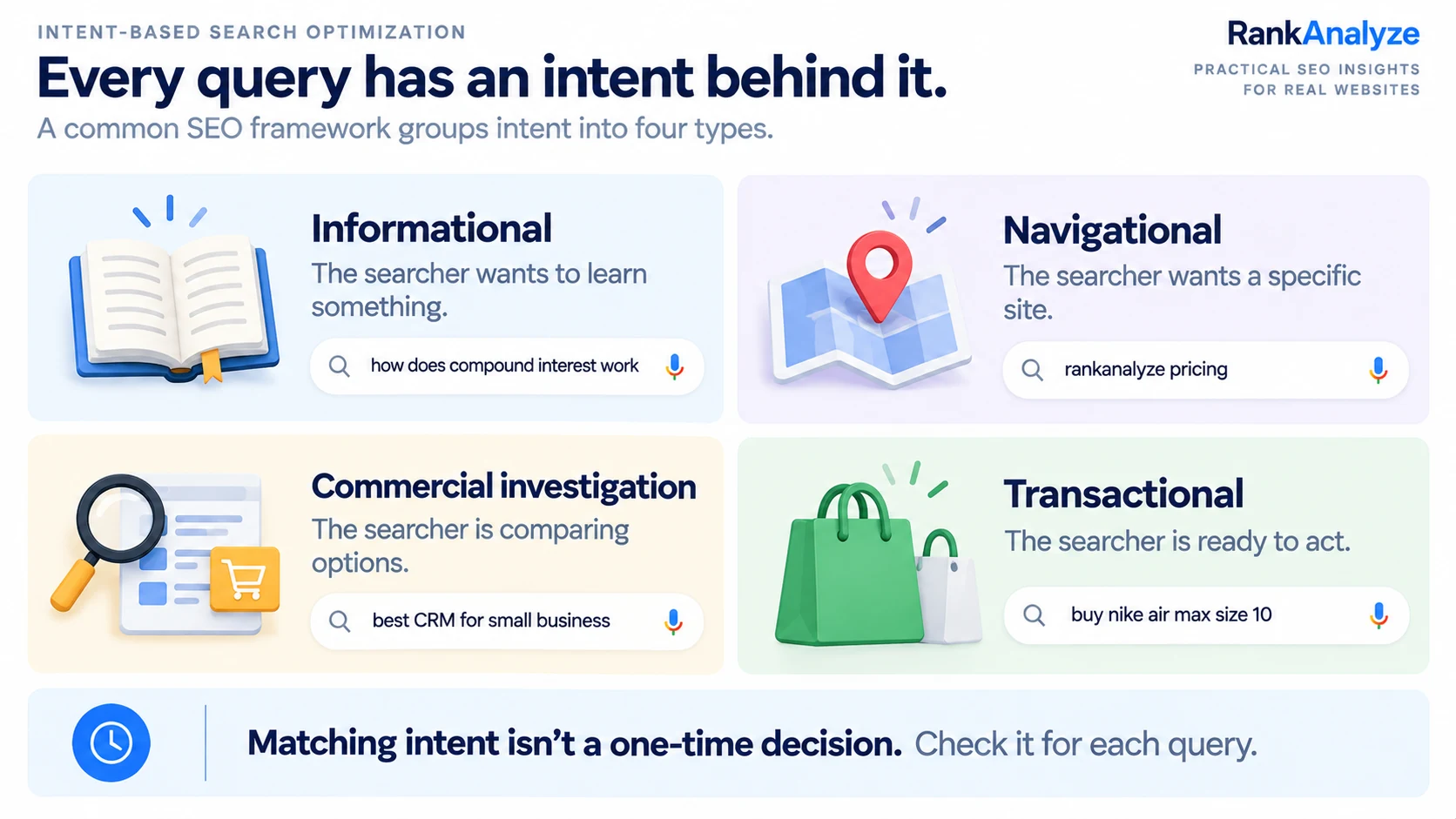
A common SEO framework divides search intent into four broad types:
- Informational — the searcher wants to learn something ("how does compound interest work"). No purchase is imminent.
- Navigational — the searcher wants a specific site or page ("facebook login", "rankanalyze pricing"). They already know where they're going.
- Commercial investigation — the searcher is comparing options before deciding ("best CRM for small business", "ahrefs vs semrush"). They're close to a decision but not there yet.
- Transactional — the searcher is ready to act ("buy nike air max size 10", "sign up for semrush").
Google's search results often reflect what it believes will best satisfy the searcher's need, not just the words in the query. Google itself recommends looking at what queries bring users to your pages and examining the results for those queries when evaluating SEO performance — that's the basis for most of the practical methods below.
This is why intent matters so much: a page can be fast, well-structured, and backed by strong backlinks, and still underperform if it answers the wrong kind of question for that query. A long informational guide is unlikely to outrank a product page for a clearly transactional query, because it isn't what the search results are currently rewarding there.
Matching intent isn't a one-time decision. Check it for each query. Map related queries to the right pages and content formats. Recheck important queries over time, because search results can shift.
See exactly how ChatGPT, Claude, Gemini, Perplexity and Copilot describe you today.
How to Identify Search Intent From Google Search Results
Answers: How do I determine intent from a search results page?
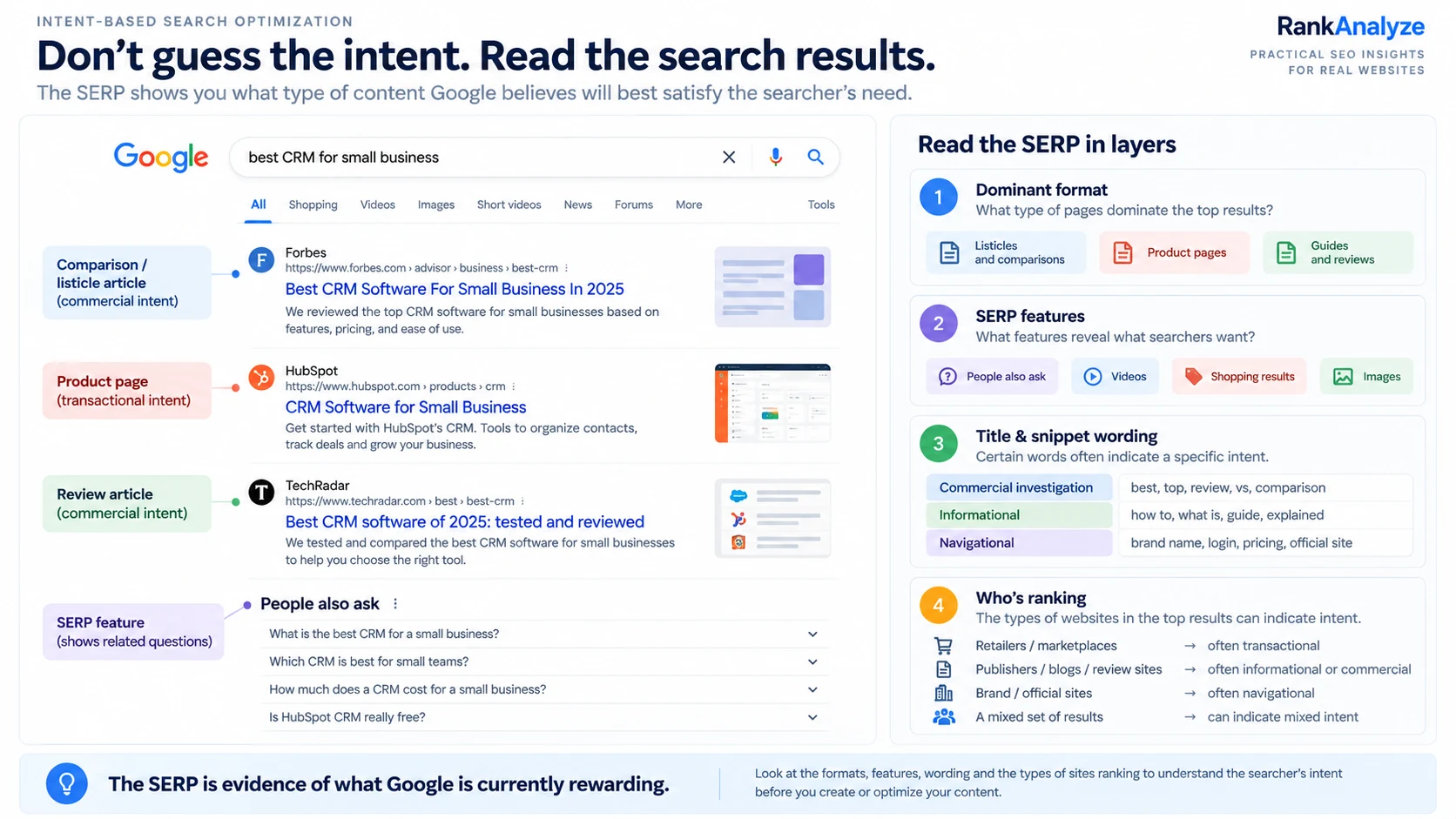
Keyword tools guess at intent using broad rules, and the guess is often wrong or too generic to act on. The search results page gives you direct evidence of what Google is currently ranking for that query, which makes it more useful than relying on a generic tool label alone.
Read it in layers:
- Dominant format. Are the top results single in-depth guides, comparison articles, product pages, or short direct answers? Whatever format shows up most in the top 5–10 results is worth treating as the safer bet for that query.
- Features on the page. People Also Ask can provide clues about the questions searchers have around a topic. Shopping results and product carousels are useful signals that products may be part of the searcher's intent. A local pack is a strong signal that local results are relevant to the query. Video carousels often mean searchers prefer to watch rather than read.
- Title and snippet wording. "Best," "top," "vs," and "review" in ranking titles point to commercial investigation. "How to," "what is," and "guide" point to informational intent. A cluster of brand names and login pages points to navigational.
- Who's ranking. Retailers and marketplaces dominating the top 10 points to transactional. Publishers, blogs, and forums point to informational. A genuinely mixed set — a forum thread next to a product page next to a guide — often means the intent itself is split; see Identifying Mixed Search Intent below.
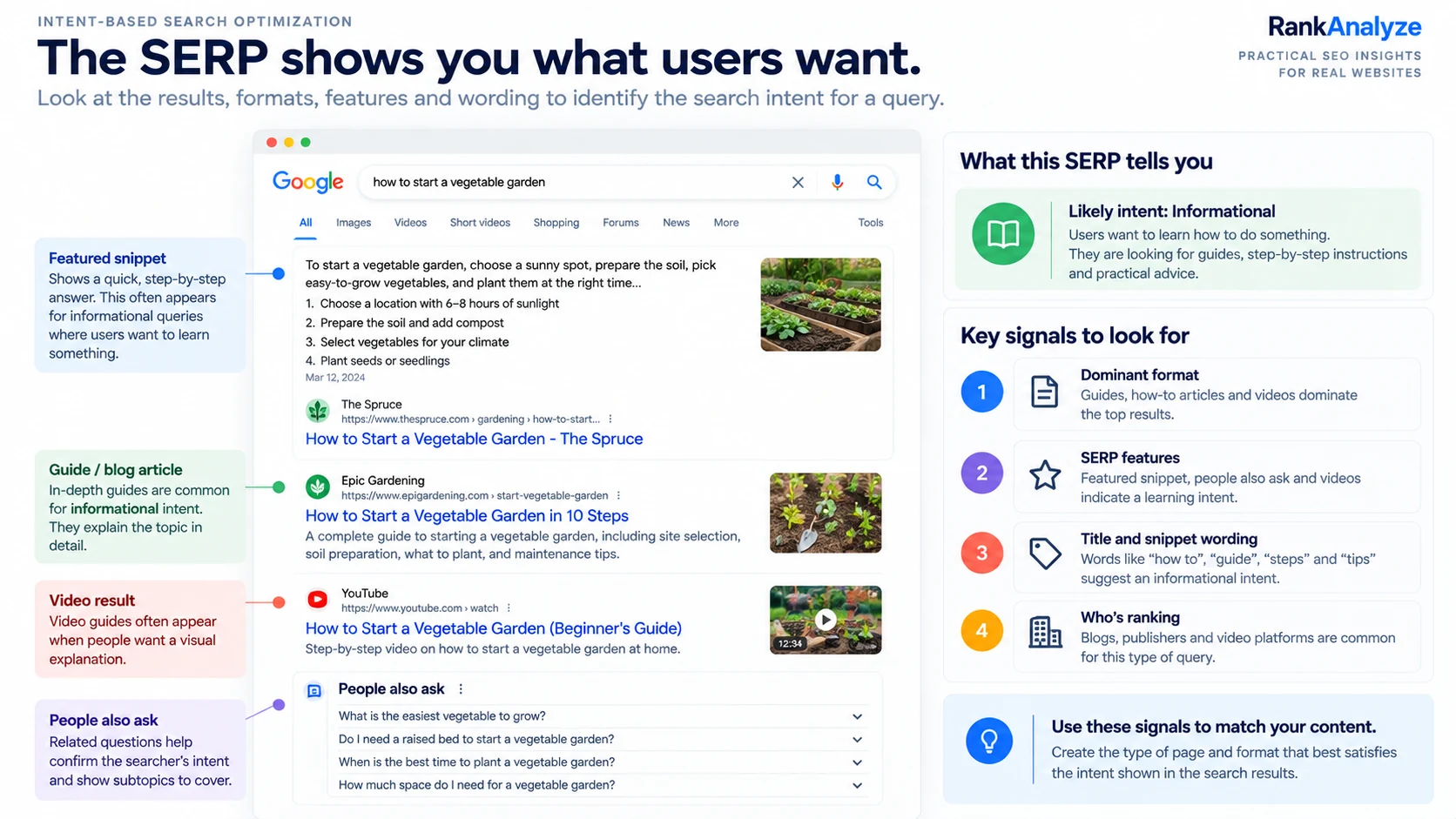
Do this read before writing anything, and again before refreshing an old page (see Optimizing Existing Content for Search Intent). It's also the fastest way to catch a mismatch early (see Detecting Search Intent Mismatch).
Pair this with real keyword volume and difficulty data rather than reading results in isolation — see SEO Keyword Research: A Step-by-Step Guide to Finding Keywords Worth Targeting.
How to Detect Search Intent Mismatch
Answers: How do I know an existing page is targeting the wrong intent?
A page can be well-written, fast, and technically sound, and still fail to rank, because it answers the wrong kind of question. This is intent mismatch, and it's easy to miss because every other signal on the page can look healthy.
Common patterns:
- Format mismatch. A single deep guide targeting a query where short, scannable listicles dominate — or the reverse.
- Depth mismatch. A short explainer targeting a query where the top results run long, with worked examples, because the searcher needs real understanding, not a one-line answer.
- Stage mismatch. A pure pricing page with a "buy now" button targeting a query where most searchers are still comparing, not ready to buy.
- Content-type mismatch. A blog post targeting a query where a category or product page dominates the results, or the other way around.
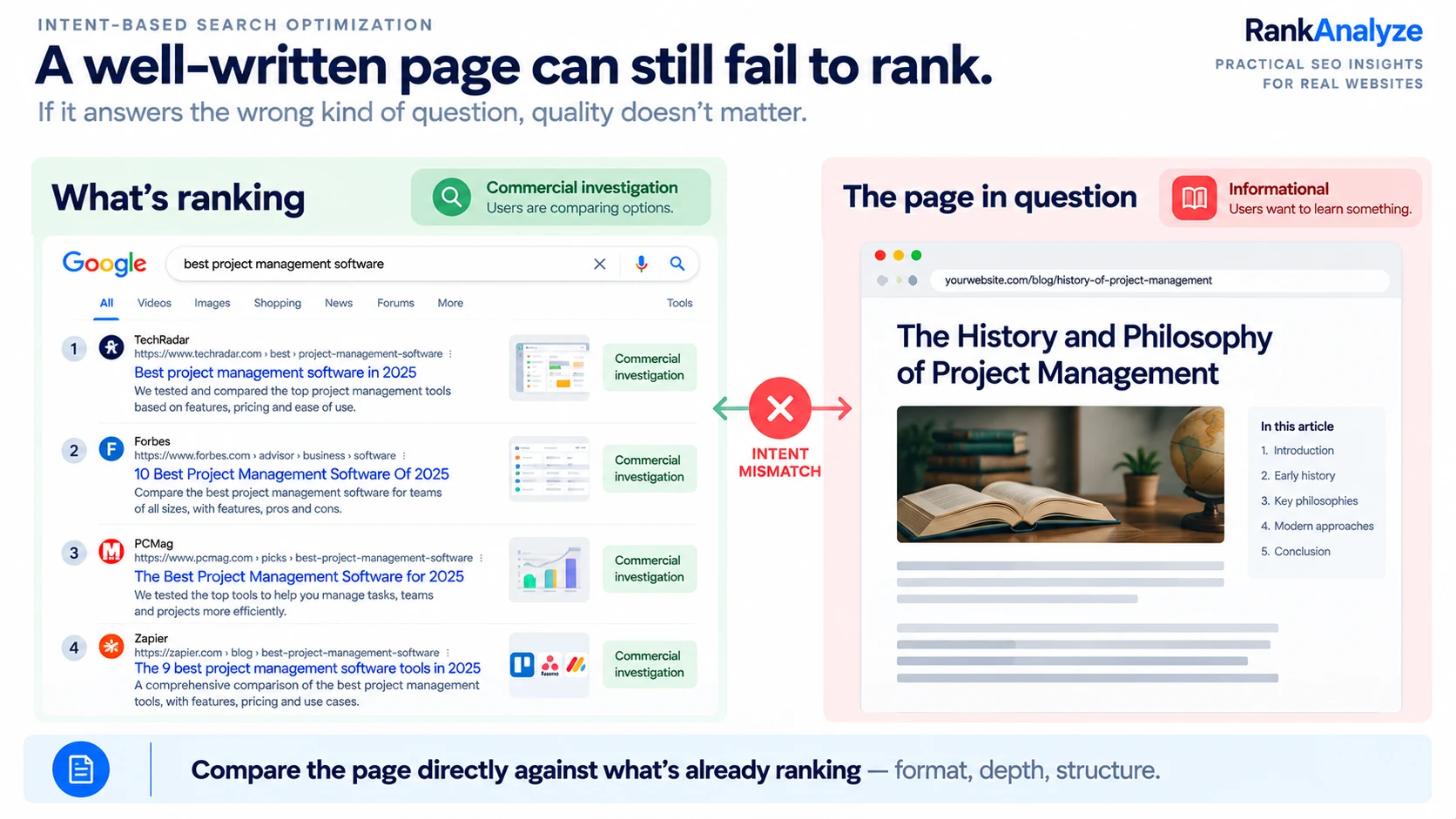
How to catch it: pull the current results for the target query (see Identifying Search Intent From Google Search Results above) and compare them directly against the page — format, depth, structure. If the page looks nothing like what's already ranking, that's the signal.
A persistent ranking plateau can be a clue that a page isn't matching well, but it isn't proof by itself — check the current results before assuming intent is the cause. See Measuring Whether Your Content Matches Search Intent below for the fuller list of signals, and Matching Your Content to Search Intent for how to fix a page once mismatch looks likely.
How to Match Your Content to Search Intent
Answers: Once I know the intent, what type of page should I build?
Use a simple framework: intent → format → depth → structure.
Informational searchers want a full answer, plus the related questions they tend to ask next (often visible in People Also Ask). Build one comprehensive guide rather than a shallow post. Include examples, not just definitions. Use clear headers so a skimmer can jump to their specific question.
Navigational searchers want the destination itself, fast. There's usually no content decision here beyond making sure the actual page — login, pricing, product — is easy to find and load quickly, without extra marketing copy in the way.
Commercial investigation searchers want to compare. Use "best X," "X vs Y," or a comparison table — something that helps someone choose, not just learn. Cover trade-offs like price, features, and limitations, but stop short of turning it into a full informational piece.
Transactional searchers want the least friction between arriving and acting. Use product or landing pages, not blog posts. Keep the page short. Put pricing, guarantees, and a clear call to action near the top.
Getting this wrong backfires in both directions. Over-explaining a transactional query loses the buyer in unnecessary reading. Under-explaining an informational query gets outranked by a page that actually answers the question.
Check the match against real competitors — see Analyzing Competitor Pages to Understand Search Intent below — and revisit it later, since intent for a query can shift: see How Search Intent Changes Over Time.
How to Tell if Two Keywords Have the Same Search Intent
Answers: Should these two keywords share a page?
Before grouping a keyword list, start smaller: do these two keywords want the same thing? Getting this wrong either way causes problems — forcing different-intent keywords onto one page dilutes it, and splitting same-intent keywords into two pages risks cannibalization (see Search Intent vs. Keyword Cannibalization below).
Three signals, most reliable first:
- Results overlap. Search both keywords and compare the top 10. If several of the same URLs show up for both, that's strong evidence the queries currently share an intent. As a working rule, 5 or more overlapping URLs in the top 10 is a strong signal, but it shouldn't be treated as a hard cutoff — the more overlap, the stronger the case.
- Shared format. Even without full URL overlap, if both queries are dominated by the same content format — both listicles, both product pages, both guides — that's a secondary signal they're aligned.
- Don't trust tool labels alone. Keyword tools often group by wording similarity rather than intent. "Affordable running shoes" and "running shoe reviews" look related on paper but can pull very different results (transactional vs. commercial investigation). Verify against the live results before relying on a tool's label.
If two keywords show substantial overlap, that's a strong reason to consider targeting them with the same page (see When Should Multiple Keywords Target the Same Page?). If they clearly diverge, they need separate pages (see When Does One Keyword Need Multiple Pages?). This check is also the foundation for larger clustering — see Clustering Keywords by Search Intent — and pairs well with volume data from proper research: SEO Keyword Research: A Step-by-Step Guide to Finding Keywords Worth Targeting.
How to Cluster Keywords by Search Intent
Answers: How do I turn a large keyword list into page groups?
- Start from the full list. Pull keywords from research tools, Search Console, and competitor research — don't filter by assumed relevance yet.
- Check overlap for likely pairs. Group keywords that show real top-10 URL overlap (see Telling if Two Keywords Have the Same Search Intent above). This is slower than automated grouping by wording, but more accurate, since it reflects the actual results rather than a guess.
- Name each group by its destination page, not its seed keyword. A group isn't "keywords about running shoes" — it's "the page that should serve all of these," which forces a real decision about what that page needs to be.
- Set aside ambiguous keywords. Some won't cluster cleanly because they cover more than one intent themselves. Don't force them in — they may need their own treatment (see When Does One Keyword Need Multiple Pages?).
- Map one group to one page, as a starting point. This isn't an absolute rule — split or combine groups later if the results show searchers actually want different things. The goal is to avoid two pages quietly fighting over the same query.
Feed the result into a structured keyword map (see Building an Intent-Based Keyword Map below). Many long-tail variants will cluster into an existing page rather than needing a new one — see Long-Tail Keywords for SEO: What They Are and How to Find Them.
When Should Multiple Keywords Target the Same Page?
Answers: When should I combine keywords onto one page?
The instinct of one keyword, one page causes problems at scale — near-duplicate pages competing against each other for the same searcher. Combine keywords onto one page when:
- They show real results overlap — the same URLs rank for both, meaning the queries currently share an intent (see Telling if Two Keywords Have the Same Search Intent).
- They're different phrasings of the same question — "how to remove background noise from audio" and "how to reduce background noise in recordings."
- Splitting them would produce two thin pages instead of one strong one. If neither keyword alone has enough substance for a full page, combining them usually produces something with more depth than either would have separately.
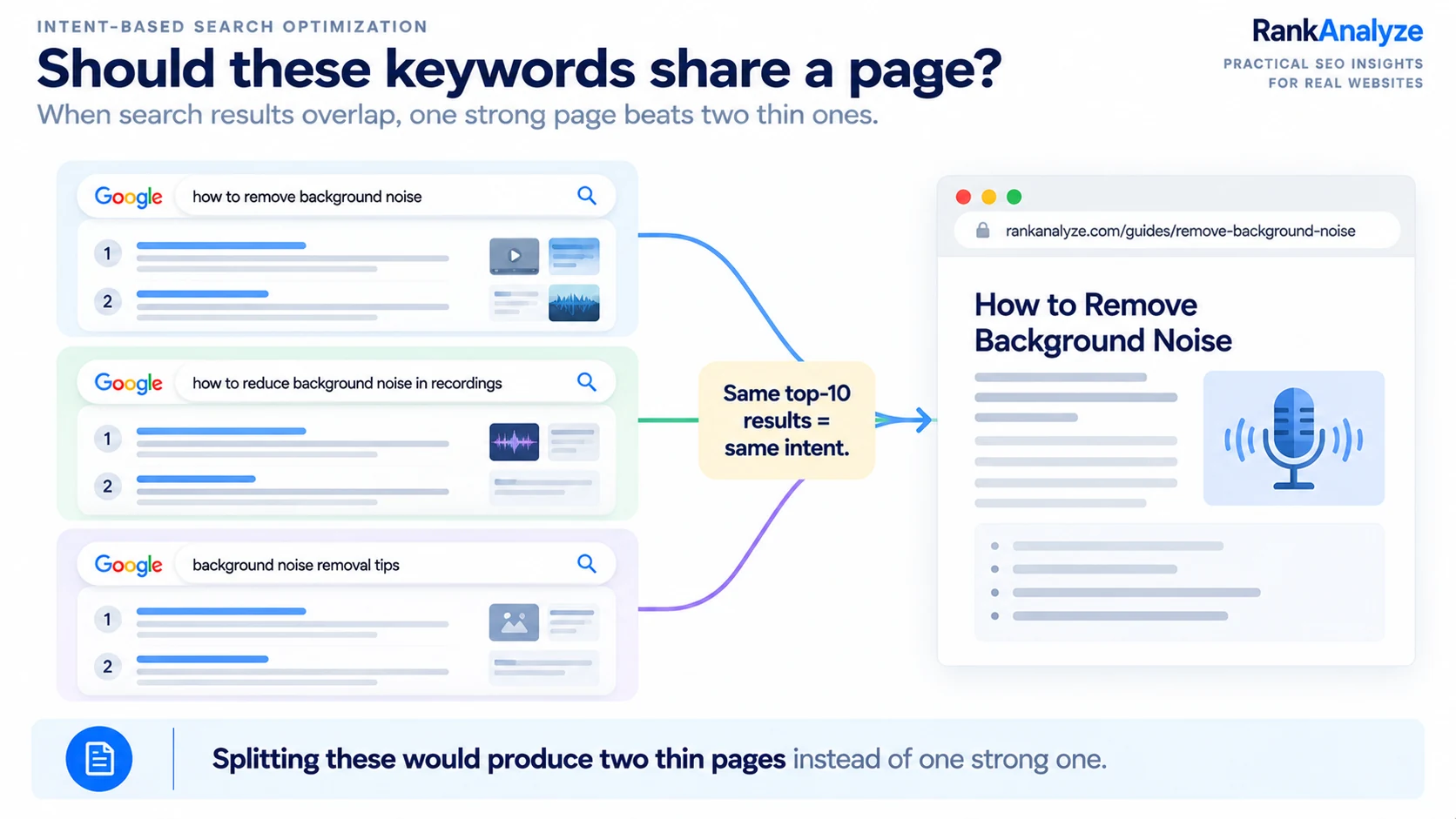
The page should still address each keyword's specific phrasing somewhere — a subheading, an FAQ entry — so it can rank for all of them, rather than optimizing narrowly for just the highest-volume one.
Getting this decision wrong the other way — building separate pages for keywords that actually share intent — can contribute to keyword cannibalization, where multiple pages compete for similar searches. See Search Intent vs. Keyword Cannibalization below and, for finding it after the fact, Keyword Cannibalization: How to Find It in Google Search Console. For the opposite case, see When Does One Keyword Need Multiple Pages? next.
When Does One Keyword Need Multiple Pages?
Answers: When should I split one keyword into multiple pages?
The consolidation habit above breaks down for keywords that are genuinely ambiguous — where the same words cover more than one real meaning. Forcing these onto one page usually means it serves neither audience well.
Classic cases:
- Homonyms. "Python" (language vs. animal), "apple" (fruit vs. company), "mercury" (element vs. planet vs. car brand). These need separate pages because the audiences don't overlap at all.
- Category vs. specific comparison. "CRM" as a broad category page (what it is, who needs one) is a different intent than "CRM" used to mean "best CRM software" — even though a keyword tool might report one volume number for both.
- Different stages hiding inside one term. A broad head term can carry both informational and commercial-investigation traffic at once. When this happens, the results page itself will often show a mixed blend of guides and product pages (see Identifying Mixed Search Intent).
- Geographic or contextual splits. The same keyword can mean something different depending on unstated context — a product name that's also a place name, or industry jargon that means something else outside that industry.
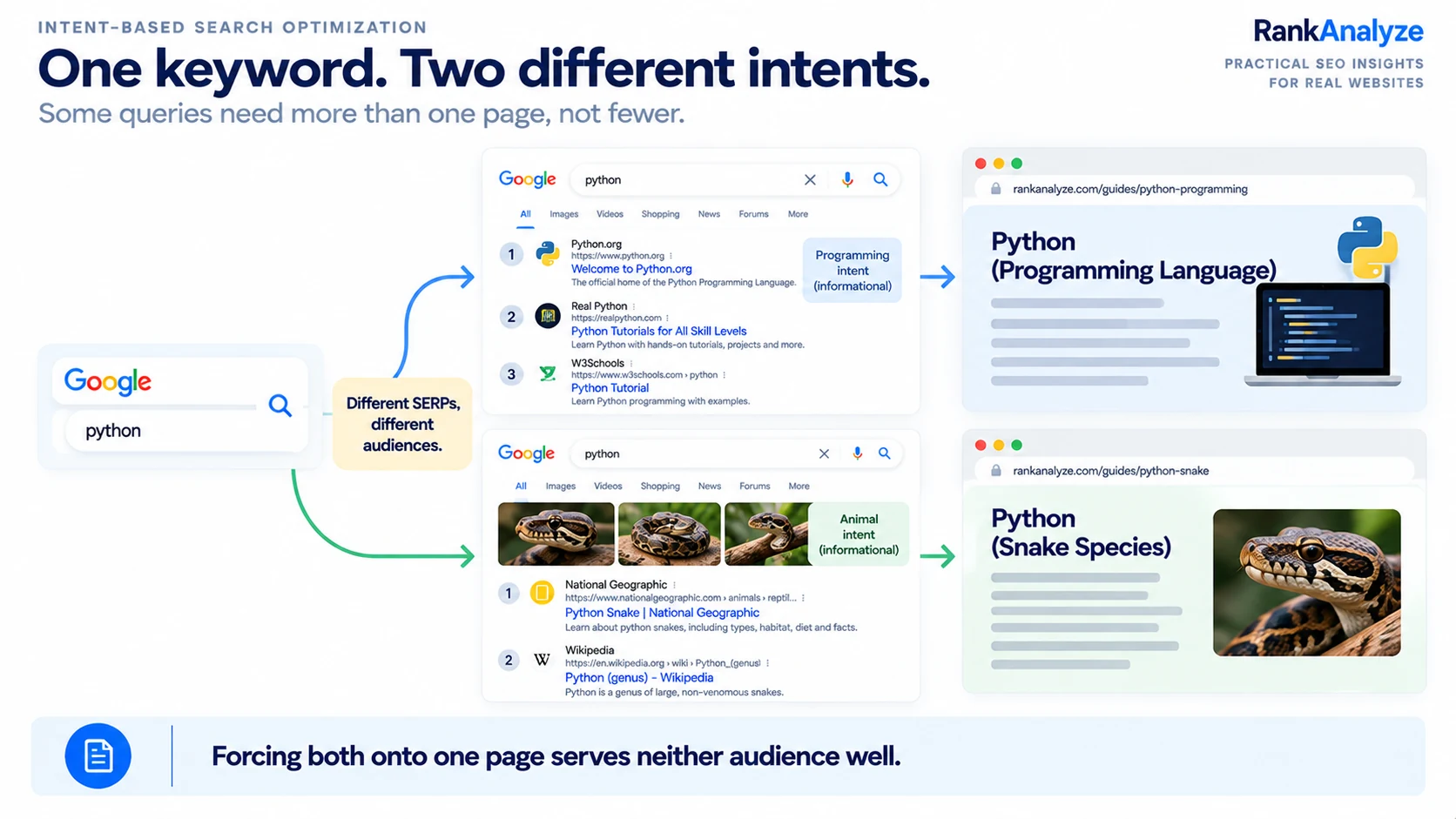
The check is the same one used elsewhere in this guide: search the keyword and see whether the top 10 splits into genuinely different groups of pages rather than one coherent theme. If it does, build separate pages, each aimed at its own version of the query. See Clustering Keywords by Search Intent for how this fits the larger process.
How to Build an Intent-Based Keyword Map
Answers: How do I document all these decisions in one place?
A keyword map turns the decisions above into one working document instead of scattered judgment calls. The core structure is four columns:
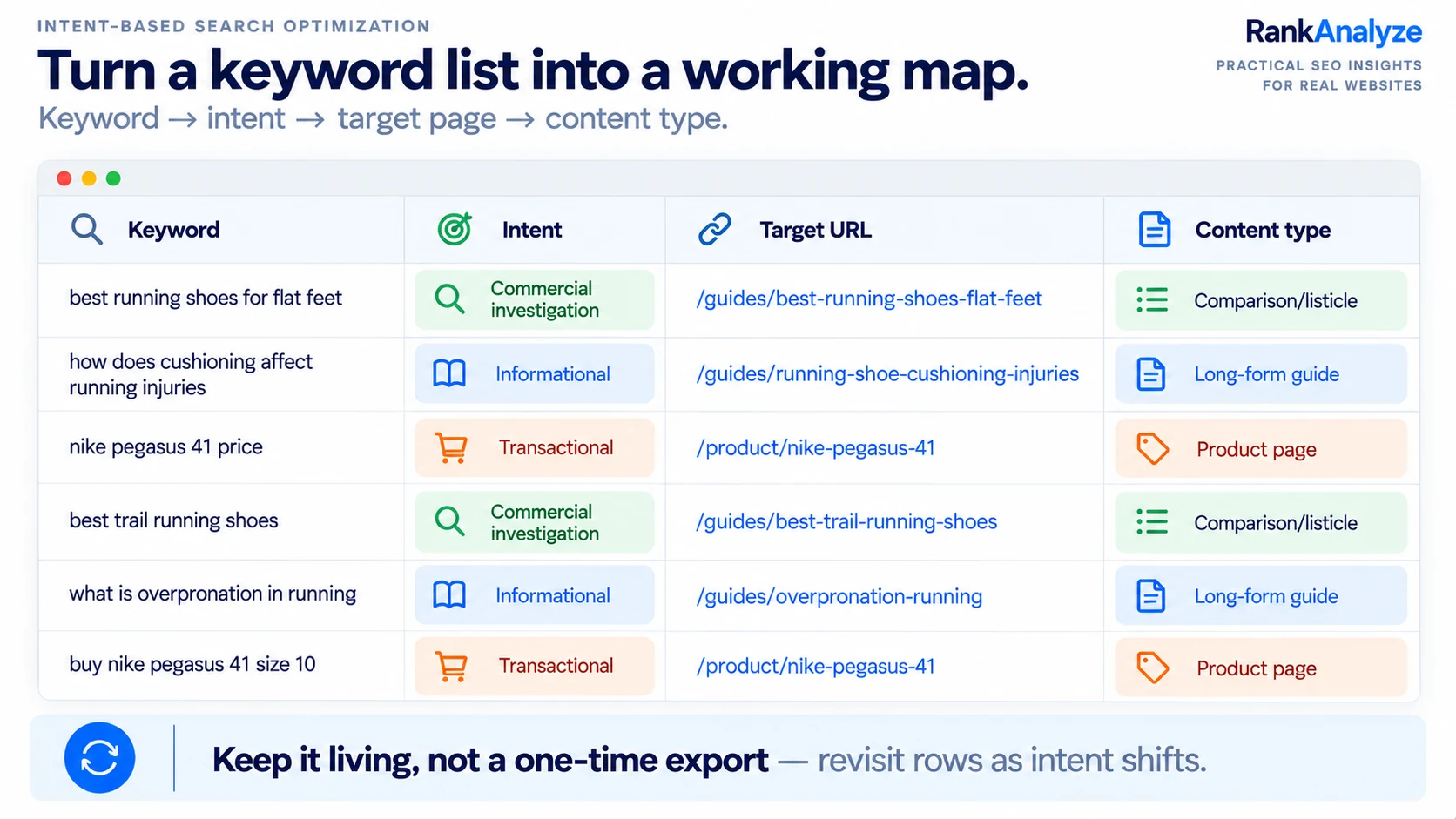
To build it:
- Start from a full keyword export — research tools, Search Console queries, and competitor gaps combined.
- Assign intent per keyword using the current results, not a tool's label (see Identifying Search Intent From Google Search Results).
- Group keywords that share intent and results overlap into one row (see Clustering Keywords by Search Intent).
- Assign a content type per row using the intent → format framework (see Matching Your Content to Search Intent).
- Mark existing vs. new URLs. Some rows map to a page that already exists — a candidate for optimization (see Optimizing Existing Content for Search Intent) — others need a new page.
Keep the map living, not a one-time export. Intent shifts, new keywords appear, and pages get merged or split as the map gets used. Revisit rows when How Search Intent Changes Over Time applies, and use the map as the reference whenever a cannibalization issue turns up — a well-maintained map is usually what prevents it in the first place.
RankAnalyze's Head-to-Head comparison view puts your page against a competitor's side by side, so studying what's already ranking doesn't mean switching between a dozen open tabs.
How to Analyze Competitor Pages to Understand Search Intent
Answers: How do I study ranking pages without simply copying them?
A keyword tool's built-in intent label is a starting point at best. It's often generic and sometimes wrong. Looking directly at what's already ranking, and asking why, is more reliable.
For each page in the top 10:
- Format and structure. Listicle, single deep guide, comparison table, product page, tool? Look at the pattern across all 10, not just the top result — one outlier doesn't define the intent, a consistent pattern across most of them does.
- Depth. Rough length, number of sections, whether it includes examples or data versus just definitions. This sets a baseline for what "enough" looks like for that query.
- What it's built to get the reader to do. Read and leave, compare and click through, or buy immediately? A page's own calls to action are a real clue to what intent its authors believed they were serving.
- Where it falls short. Thin sections, outdated information, sub-questions visible in People Also Ask that the page doesn't answer. This is the actual opportunity — not imitation, but filling the gap.
Run this before writing something new, and again periodically for existing pages, since competitors change and results shift over time (see How Search Intent Changes Over Time). It's also a fast check against keeping a page whose format doesn't match what's already working for that query (see Detecting Search Intent Mismatch).
How to Identify Mixed Search Intent
Answers: What do I do when the results page itself is split?
Not every query resolves to one clean intent. Some results pages show a genuine blend — a how-to guide next to a product page next to a forum thread — because there isn't one dominant intent for that query yet. Treating a mixed query as if it had one answer usually produces a page that underperforms against every format actually present.
How to spot it: look at the top 10 as a set, not one at a time. If it splits into two or more genuinely different groups — say, half guides and half product pages — rather than one theme with minor variation, that's mixed intent. This is different from format variety within one intent; several different-looking guides are still all informational.
Once mixed intent is confirmed, the options are:
- Pick the larger group and target it directly, accepting the page won't compete for the other slice.
- Build separate pages for each intent — often the right call when both slices are substantial, similar to the split described in When Does One Keyword Need Multiple Pages?.
- Build one page that briefly serves both, only when one intent is clearly the minority — for example, a mostly informational guide with a short, clearly-marked comparison section.
Mixed intent shows up especially in queries that are actively shifting — a market maturing, a topic becoming more commercial — so it's worth checking against How Search Intent Changes Over Time below before treating it as permanent rather than a snapshot mid-change.
How Search Intent Changes Over Time
Answers: How do I detect when yesterday's approach stops working?
A query's dominant intent isn't fixed. It shifts as user behavior changes, as search features evolve, and as the underlying topic or market matures. A page that matched intent well at launch can drift out of alignment later, without anything on the page itself having changed.
Common drivers:
- Market maturity. A brand-new product category tends to start informational-heavy, since searchers are learning what the thing even is. As the category matures, the same queries often shift toward comparison and eventually purchase.
- New search features. AI-generated overviews, expanded People Also Ask, new carousel types — these change what "matching intent" looks like in practice, even when the underlying need hasn't changed.
- Seasonality and news events. Some queries swing intent temporarily around a relevant event or season, then revert.
- Gradual shifts in the results. If the results page gradually shifts toward a different format over time, pages that once matched the query well may become less competitive.
Treat intent-matching as a recurring check, not a one-time decision made at publish time. Re-run the results check (see Identifying Search Intent From Google Search Results) on a schedule for important pages. Watch for rankings that were stable and start slipping with no obvious technical cause — a possible drift symptom, though not proof on its own (see Measuring Whether Your Content Matches Search Intent below). Feed anything that looks drifted into the standard refresh workflow, next.
How to Optimize Existing Content for Search Intent
Answers: What exactly do I change once intent has shifted?
This is a narrower version of a general content audit (see Website Content Audit: A Step-by-Step Framework for the broader process), focused specifically on whether a page's format still matches the current results, not freshness or accuracy.
- Re-check the current results for the page's target query. Don't rely on how it looked when the page was written — check it now (see Identifying Search Intent From Google Search Results).
- Compare format, depth, and structure against what's ranking today. Has the dominant format shifted? Has typical depth increased as competitors expanded their coverage?
- Name the specific gap. Not "this page needs to be better" — concretely: it's missing a comparison table competitors now have, or it doesn't answer questions that now show in People Also Ask.
- Make structural changes, not just word-count padding. Adding more words to an already-informational page won't fix a format mismatch. Add the missing section or table, and cut what no longer earns its place.
- Monitor after the change lands. Track impressions, clicks, CTR, and position over time once the update is indexed. If performance doesn't improve, look at other possible causes rather than assuming the intent diagnosis was correct.
This workflow is the direct fix for the drift described in How Search Intent Changes Over Time above, and it should be triggered by the signals in Measuring Whether Your Content Matches Search Intent below rather than run on a fixed schedule regardless of need.
How to Measure Whether Your Content Matches Search Intent
Answers: How do I know whether a change actually worked?
Intent mismatch rarely announces itself with one clear signal. It usually shows up as a set of metrics that are individually ambiguous but worth reading together:
- A ranking plateau that won't move. A page sits at position 12–25 for a long time despite reasonable backlinks and no technical issues. This can be a clue that the page isn't satisfying the results well, but it isn't proof — check the current results before concluding intent is the cause.
- Lower click-through than a position should get. If a page ranks around position 4–6 but earns less traffic than that position usually produces, the title and description may be promising something the searcher doesn't actually find once they click through.
- Short time-on-page. This can mean the content didn't match what the searcher expected — or it can mean the page answered the question efficiently, which is a good outcome. Read this signal together with the others, not alone.
- Comparing the page's format against what's currently ranking. Note the dominant format, depth, and structure across the top 10, then compare the page directly against it. A page that looks structurally different from everything else ranking is a useful qualitative check, worth doing even before the other metrics move.
None of these signals proves mismatch by itself. Read them together, and always check the current results before concluding a page needs rework. Once mismatch looks likely, use the refresh workflow above under Optimizing Existing Content for Search Intent.
Search Intent vs. Keyword Cannibalization: What's the Connection?
Answers: Is this an intent problem or a page-conflict problem?
These look similar in the data — two of a site's own pages competing for one query, rankings that seesaw between them, combined traffic lower than either page should get alone — but they're not the same problem. Cannibalization can have more than one cause. Intent mismatch is one possible cause, not the only one.
One common version of the connection:
- Under-grouping. Two keywords that actually share intent get treated as separate targets, and two pages get built for what should have been one. Both pages may end up competing for the same searches, making it harder to tell which one should serve that query. This is the failure mode covered above under When Should Multiple Keywords Target the Same Page? — the fix is consolidation, not more optimization on either page.
- Over-consolidation causes a different failure. One page tries to serve two genuinely conflicting intents at once — say, a broad explainer and a narrow sales pitch — and ends up matching neither well. This maps to When Does One Keyword Need Multiple Pages? above.
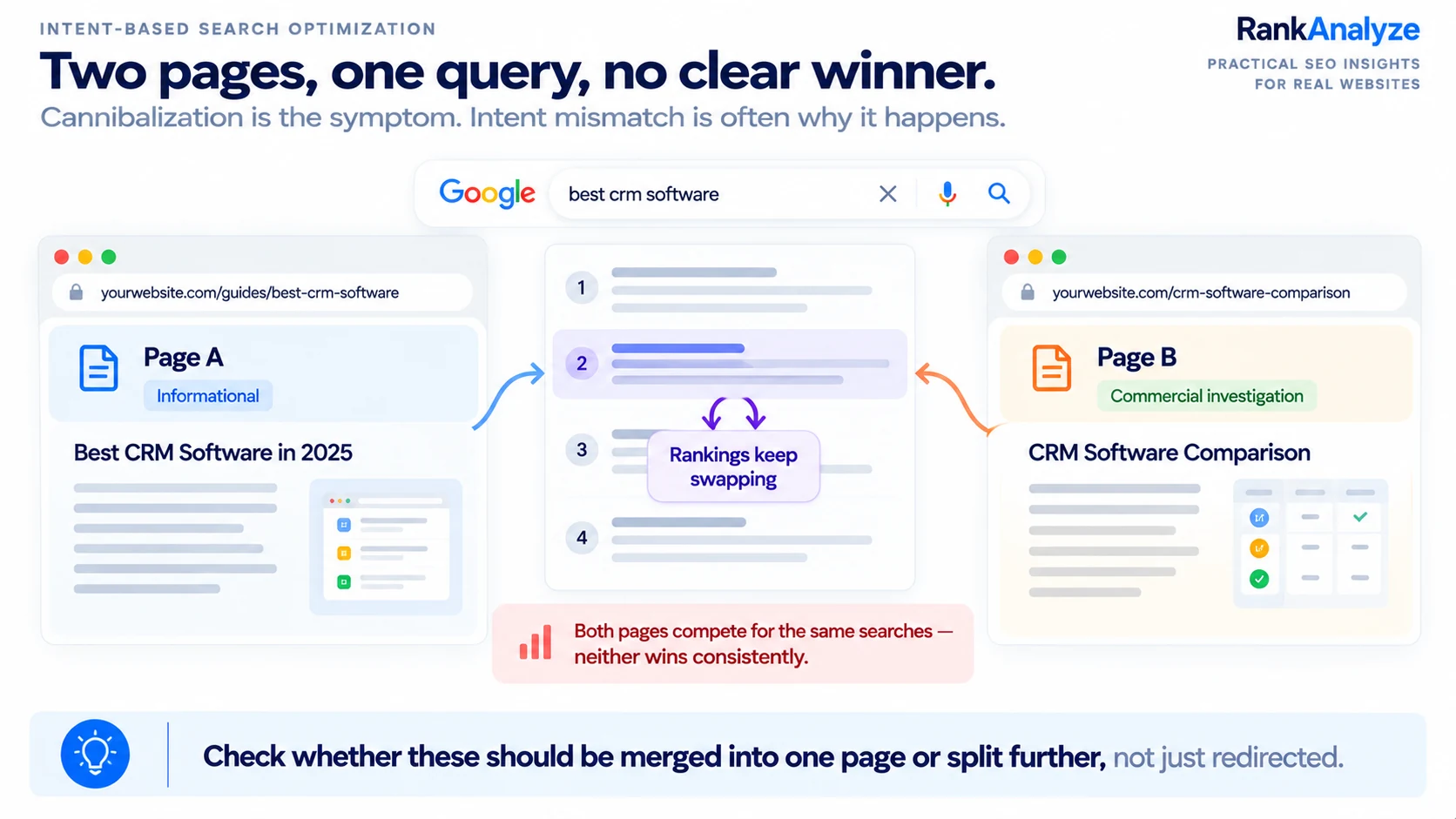
Diagnosing which situation applies starts the same way either problem gets found: Keyword Cannibalization: How to Find It in Google Search Console shows how to spot the symptom (multiple URLs from one site ranking and swapping positions for one query). From there, the intent check (see Telling if Two Keywords Have the Same Search Intent above) determines whether the fix is merging pages or splitting them further, rather than treating it as a purely technical redirect problem that fixes the symptom without addressing why it happened.
A quick recap
- Read the SERP in layers before assuming intent from the keyword alone
- Compare a page directly against what's ranking to catch mismatch
- Match format, depth, and structure to the intent type
- Group keywords by results overlap, not by wording similarity
- Split genuinely ambiguous keywords into separate pages
- Keep a living keyword → intent → URL → content-type map
- Recheck important pages periodically — intent drifts
- Diagnose cannibalization as either under-grouping or over-consolidation
See exactly how ChatGPT, Claude, Gemini, Perplexity and Copilot describe you today.