Topical Authority: What It Actually Means and How Topic Clusters Build It
"Topical authority" gets mentioned in a lot of SEO articles in 2026, often as if it is replacing backlinks as one of the main ways to build search visibility. The idea itself isn't new, and it isn't magic. It describes what can happen when a site covers a subject in enough depth and connects its pages in a clear structure. Search engines can use that structure, while AI systems may have more connected pages available to retrieve or cite. Over time, a site built that way can establish stronger credibility around the subject. Topic clusters are one common way to build that coverage. Here's what both terms actually mean, how to build a cluster without just publishing more pages, and how to tell whether it's working.
What Topical Authority Actually Means
Topical authority isn't a score you can check in one place, and no search engine or AI company has published an exact formula for it. What we can observe is simpler: sites with deep, accurate, well-linked coverage can build stronger coverage of a subject than a single page trying to rank on its own. One well-written article can rank for its own keyword. A connected set of pages that covers a topic's main questions, sub-questions, and edge cases is different. Together, those pages can show that a site covers the subject more broadly than a one-off article.
That's the theory. The practical version: if a competitor has fifteen pages answering questions about a subject and you have one, depth is working against you before content quality even enters the picture.
What a Topic Cluster Actually Is
A topic cluster starts with a pillar page covering a broad topic. Around it are cluster pages that cover specific sub-topics in more detail. The pages link to the pillar and to other relevant pages in the cluster. Our guide to SEO keyword research already covers how to group individual keywords into one cluster before you write anything. This guide picks up from there. Once you've grouped keywords into a cluster, the next step is to build useful pages around the real sub-topics and connect them with internal links. Over time, that can give your site broader coverage of the subject.
The word "cluster" implies more structure than a typical site actually has. In practice, many sites have scattered pages that happen to cover related subjects, published over time, rarely linked to each other, often written by different people, with no page anyone would call the "main" one. That's not a cluster. It's the raw material for one.
How to Build One, Step by Step
- Pick a pillar topic broad enough to need multiple pages, narrow enough that you could realistically cover it. "Email marketing" is too broad for most sites to cover comprehensively. "Email marketing for ecommerce" is a narrower topic a mid-sized team could realistically build out.
- Map the real sub-topics, not just keyword variations. Read what your audience actually asks, in support tickets, forum threads, and the "People also ask" boxes for your pillar keyword. A sub-topic is a distinct question or use case, not simply a different way of phrasing the same question. Our keyword research guide covers this distinction in more detail.
- Build the pillar page as an overview, not a summary of everything. Its job is to define the topic, cover it at a level someone new to the subject can follow, and link out to every cluster page that goes deeper.
- Build or identify a cluster page for each sub-topic. Check what you already have before writing anything new. A page you published two years ago may already cover the sub-topic. It might only need an update and a few internal links.
- Link deliberately. Every cluster page should link back to the pillar and to other cluster pages when those links are genuinely useful to the reader. Don't add links just to hit a number.
- Fill the gaps you find, don't just publish more. If step 2 surfaced a sub-topic nobody on your site covers, that's the actual work. Publishing another page on a sub-topic you already cover well doesn't close a gap. It just adds a second page competing with the first.
A Worked Example: Mapping a Cluster From Real Search Data
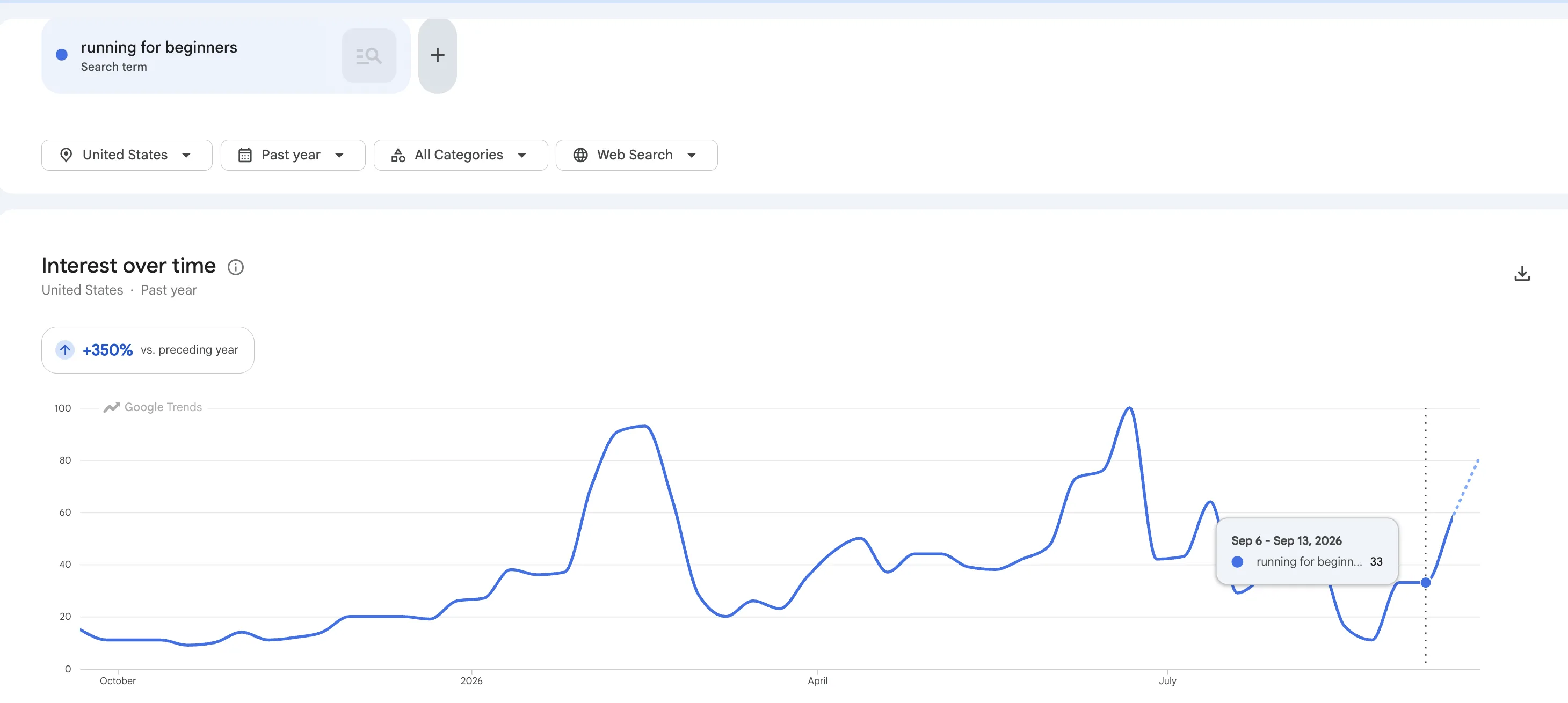
Steps 1 and 2 are easier to see than to describe, so here's what they actually look like against real data instead of a hypothetical. Take a pillar like "Running for Beginners." It's a common content topic with plenty of related questions. We checked Google Trends for "running for beginners" in the United States over the previous 12 months, using data available in September 2026. Google Trends reports relative interest on a scale of 0 to 100, not raw search volume, and it only scores up to five terms against each other at a time. The sub-topic numbers below come from three separate five-term comparisons, so they're directly comparable within each group but not across groups — a term's score depends partly on what it's plotted against, not just how often people search it.
The data shows clear seasonality: interest starts at 15 in late September 2025, climbs to a peak of 93 in mid-February (the New Year's-resolution spike you'd expect), and peaks again at 100 in late June. By the week of September 6–13, 2026, it had climbed back to 33, with the final week of data trending higher still — Google Trends marks that most recent stretch as provisional, since it can shift as more data comes in. That's not a flat example. It's a topic with a real annual rhythm.
The obvious next step is a list of candidate cluster titles, something like: How to Start Running as a Beginner, How Often Should Beginners Run?, Running vs Walking, Best Running Shoes for Beginners, How to Prevent Running Injuries, What to Eat Before a Run, What to Eat After a Run, How to Improve Running Speed, a 5K Training Plan for Beginners, How to Increase Running Distance Safely, Running for Weight Loss, Zone 2 Running, How to Warm Up Before Running, How to Recover After a Run, and Common Running Mistakes. Fifteen plausible pages. We checked what real search demand exists behind each one, individually, rather than assuming the list itself was the plan.
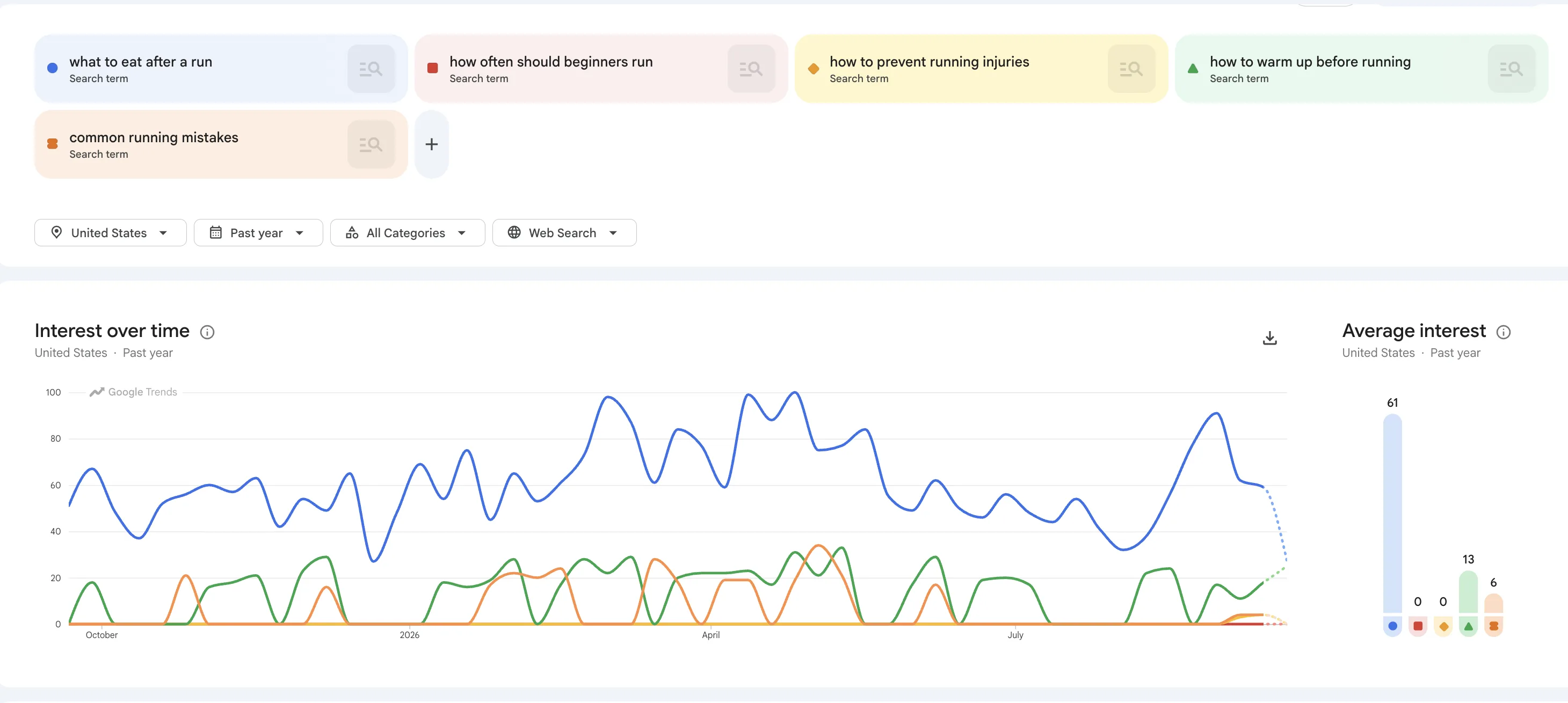
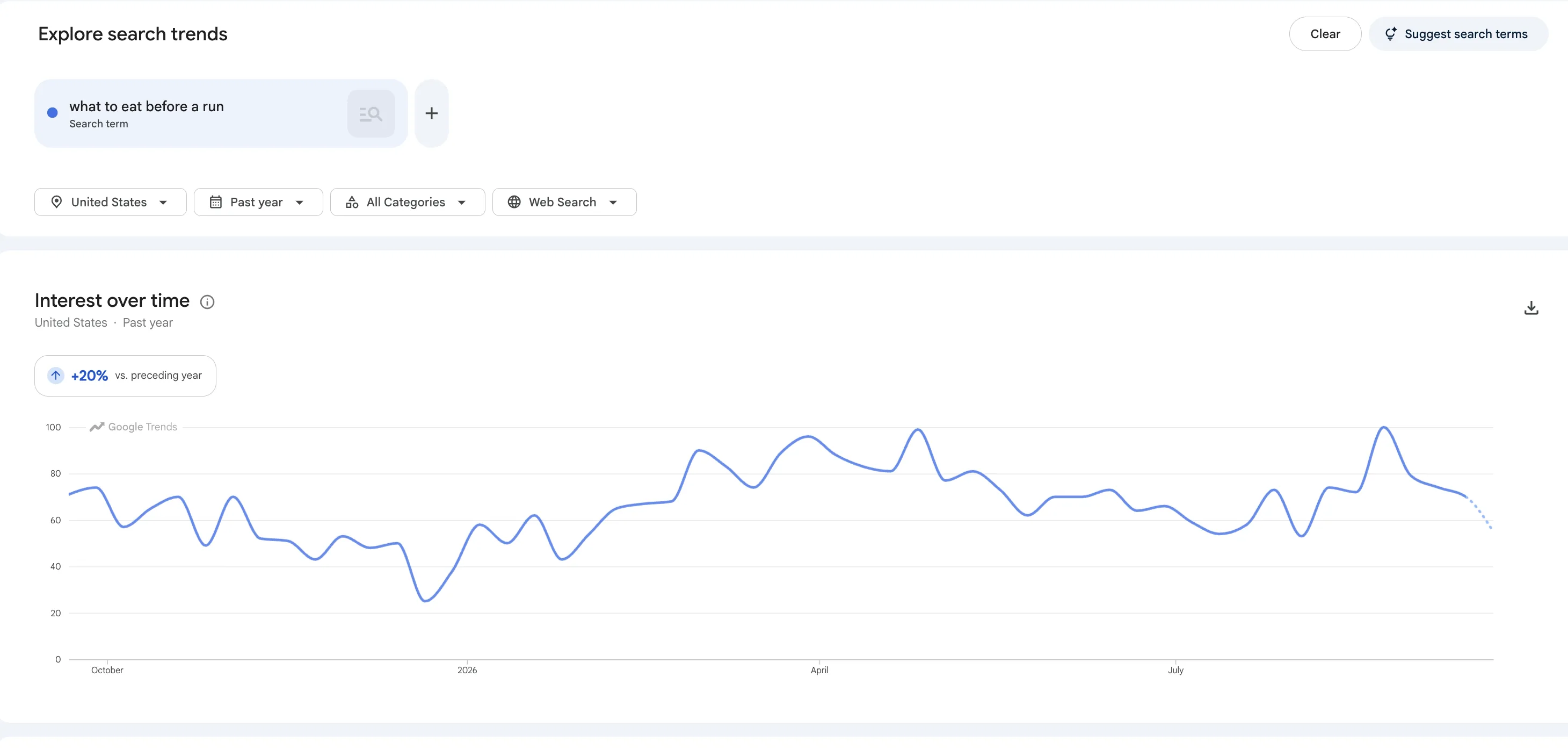
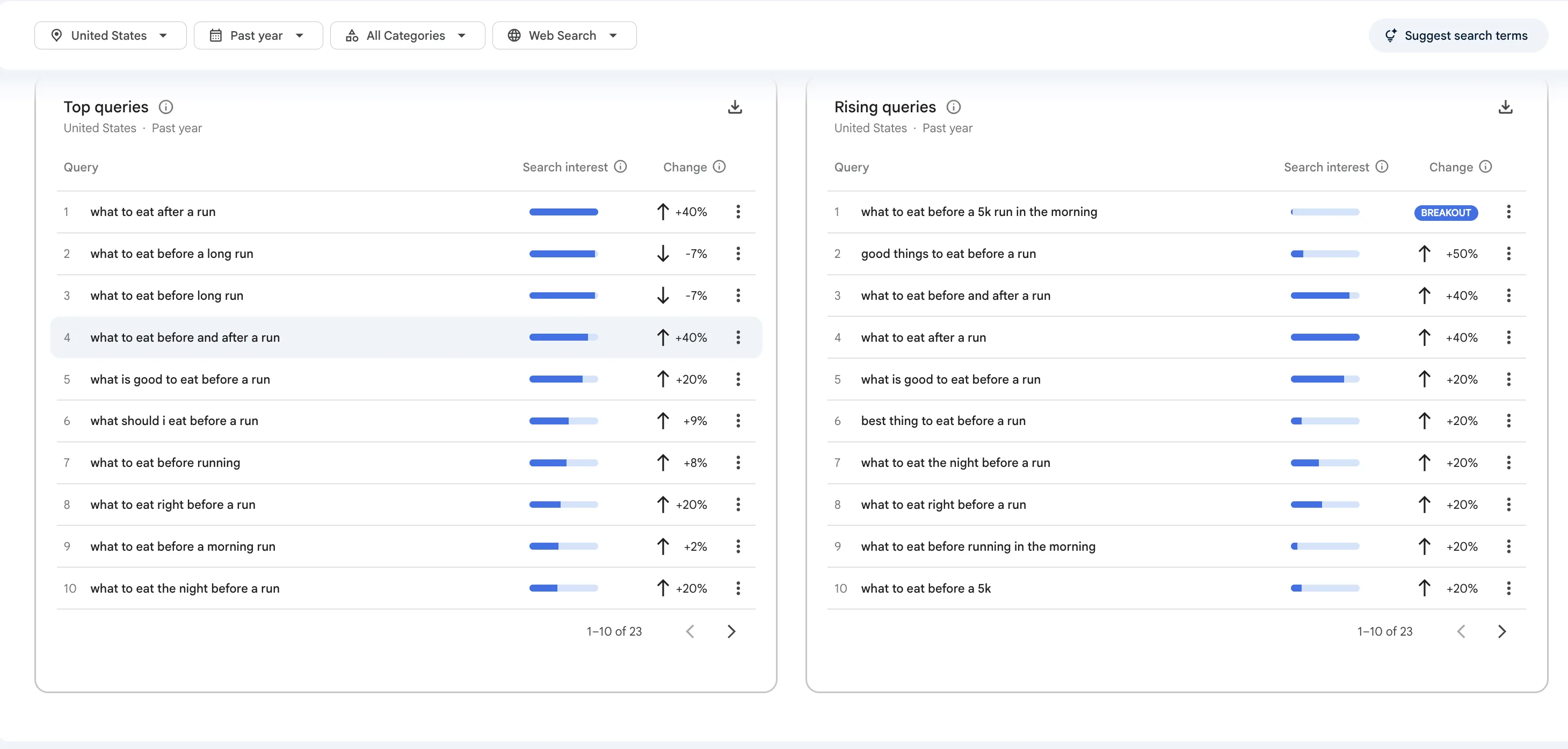
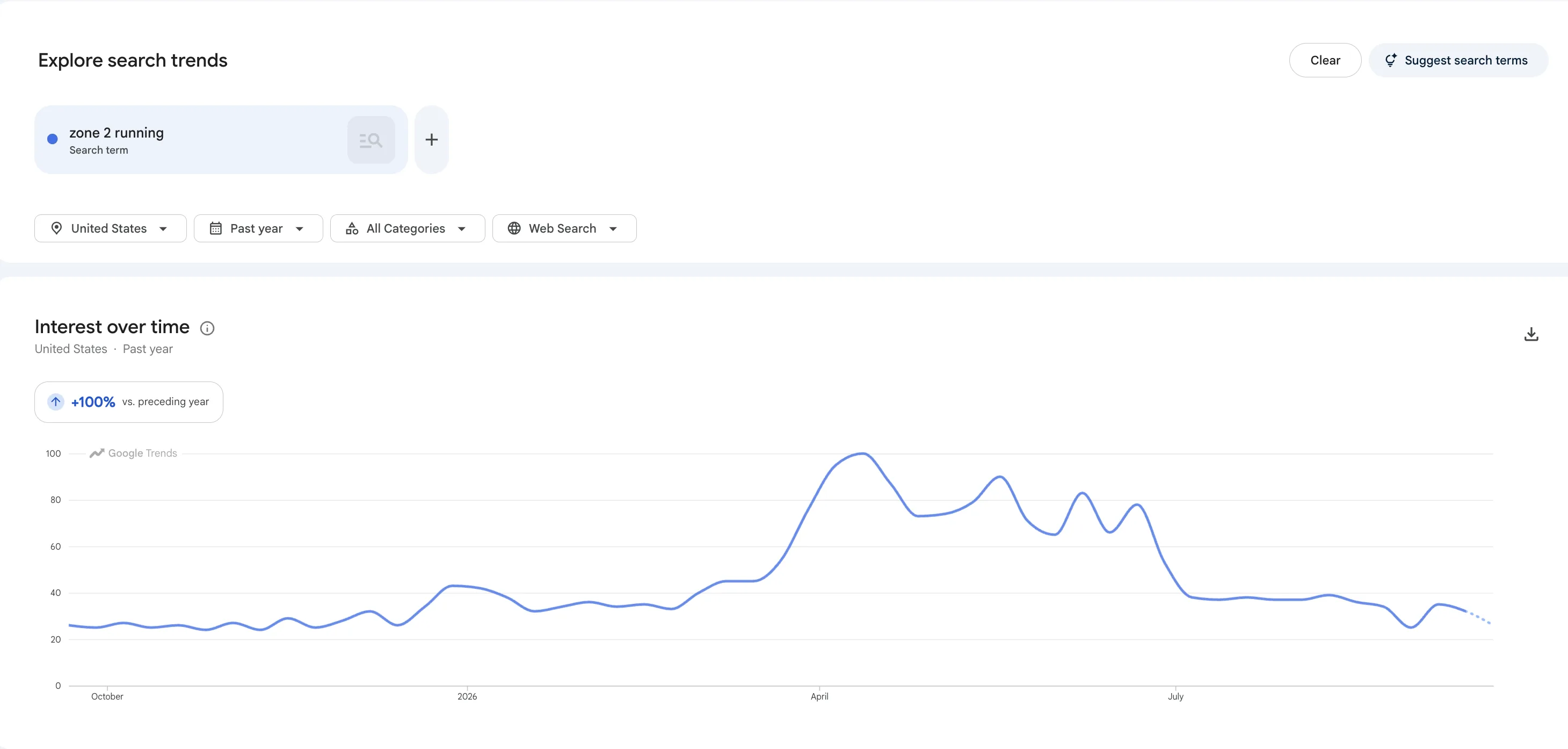
Grouped together, "how to start running" led its five-term comparison with an average relative interest of 48, followed by "running for weight loss" (16), "zone 2 running" (14), and "running vs walking" (12). In its five-term comparison, "what to eat after a run" had the highest average relative interest we saw, at 61. "What to eat before a run" wasn't in that comparison — on its own it ranges from about 25 to 100 across the year, with Google Trends showing a 20% year-over-year increase in relative interest, a reminder that these averages are relative to whatever else is in the comparison, not an absolute ranking across all fifteen candidate titles.
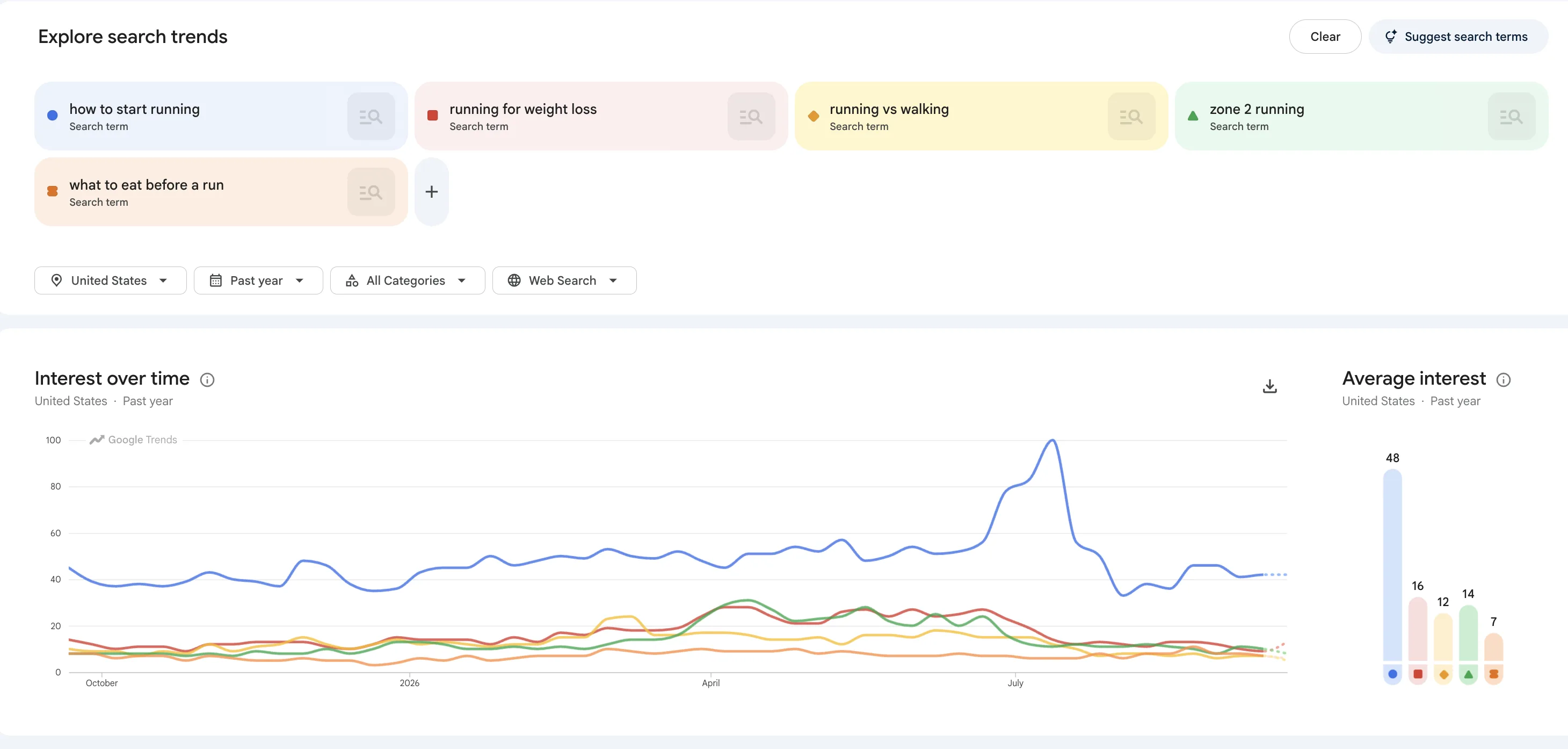
Related-query data settles what a page split would miss: search for "what to eat before a run" and the top related queries include "what to eat after a run" and "what to eat before and after a run" directly, meaning people are already asking about both halves of the question together. That's a real argument for one page instead of two thin ones. The comparison also suggests that "what to eat after a run" deserves particular attention, while the separate trend for "what to eat before a run" shows that its demand varies significantly over the year. It's the kind of judgment call Step 2 is designed to surface.
Several of the fifteen candidate titles came back close to zero under their exact phrasing: "how often should beginners run" and "how to prevent running injuries" both averaged 0, "how to increase running distance" averaged 3, "common running mistakes" averaged 6, and "how to warm up before running" averaged 13. That doesn't mean the sub-topic is wrong. It means the literal phrasing isn't what people type into Google. These are still real questions worth answering inside a cluster, just not pages to expect much direct search traffic from on their own.
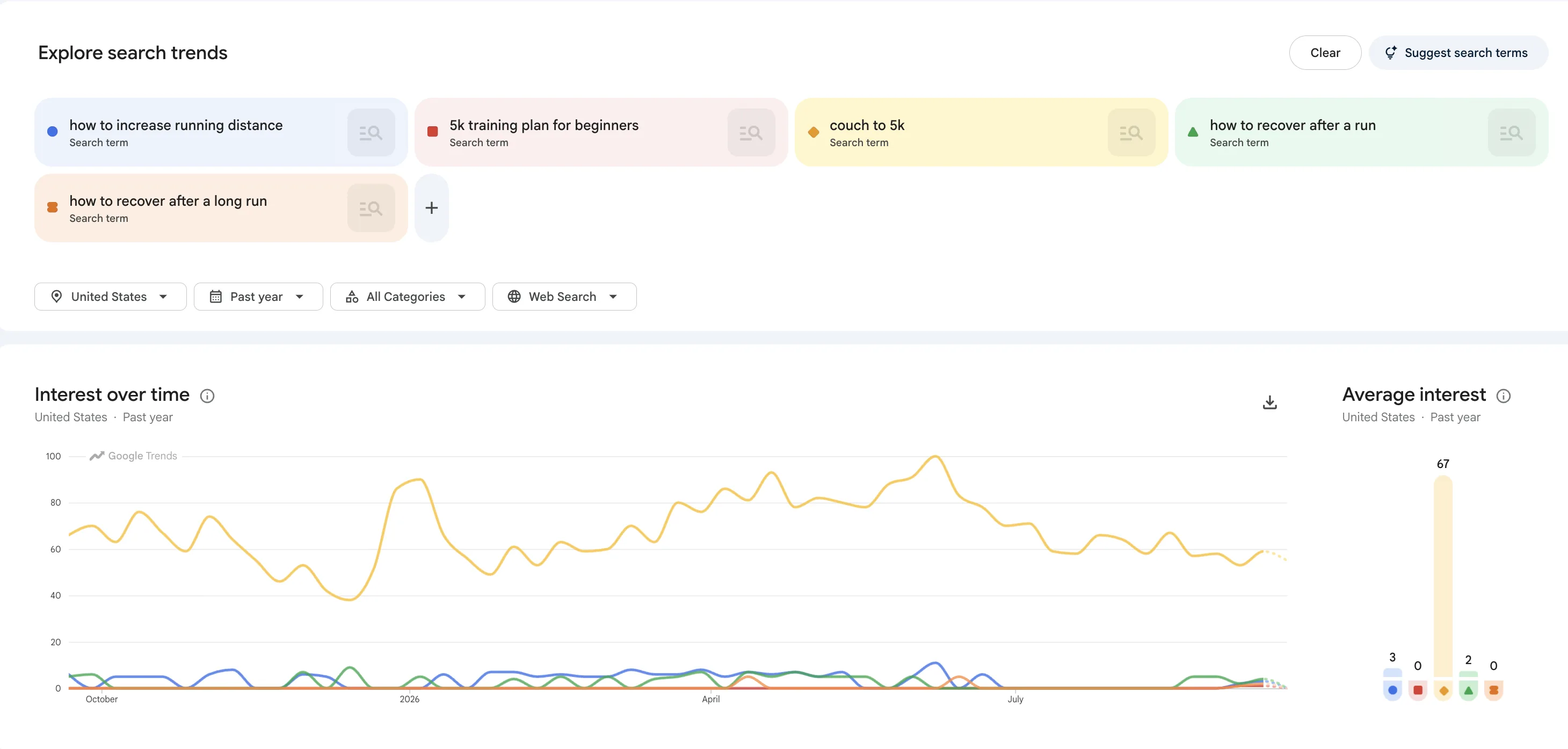
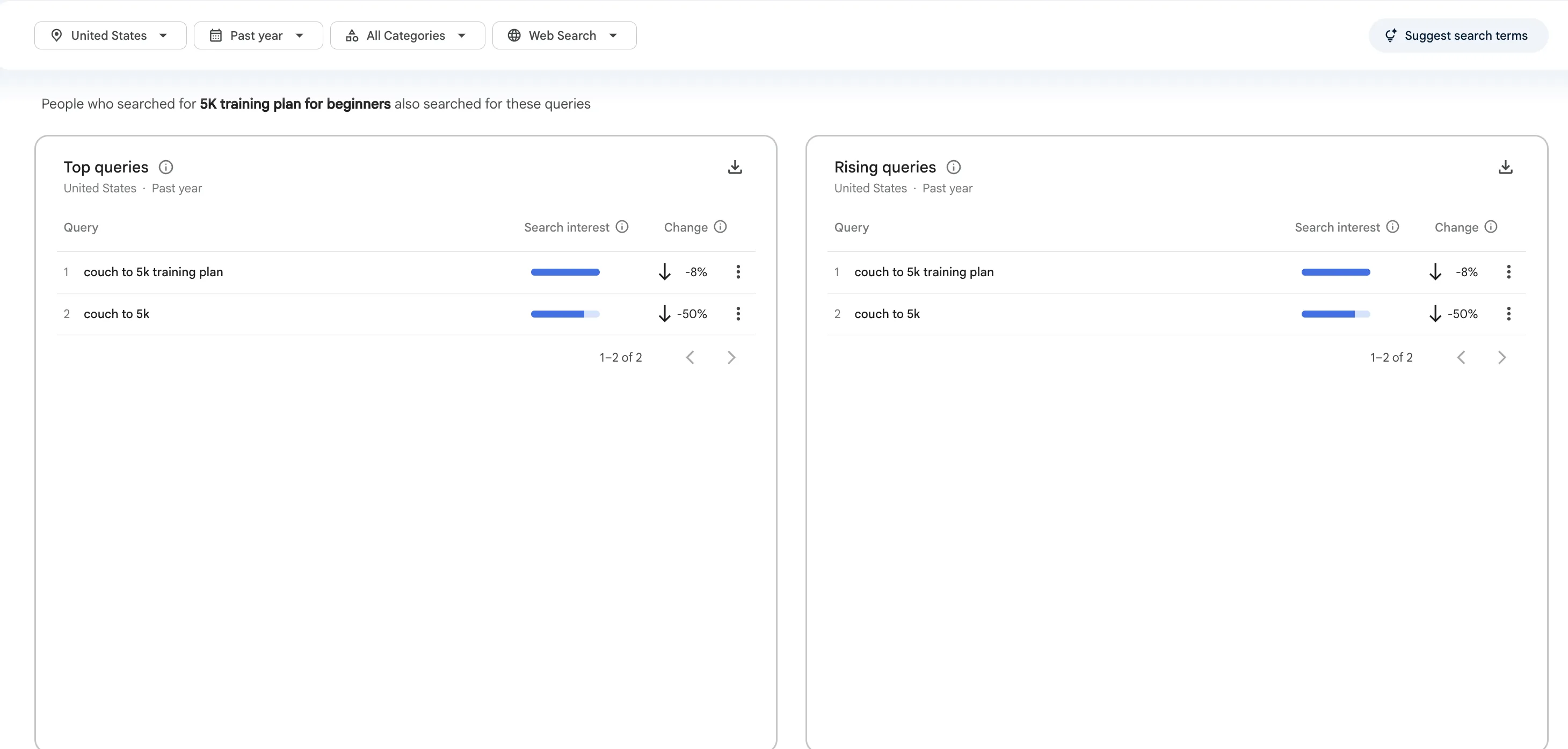
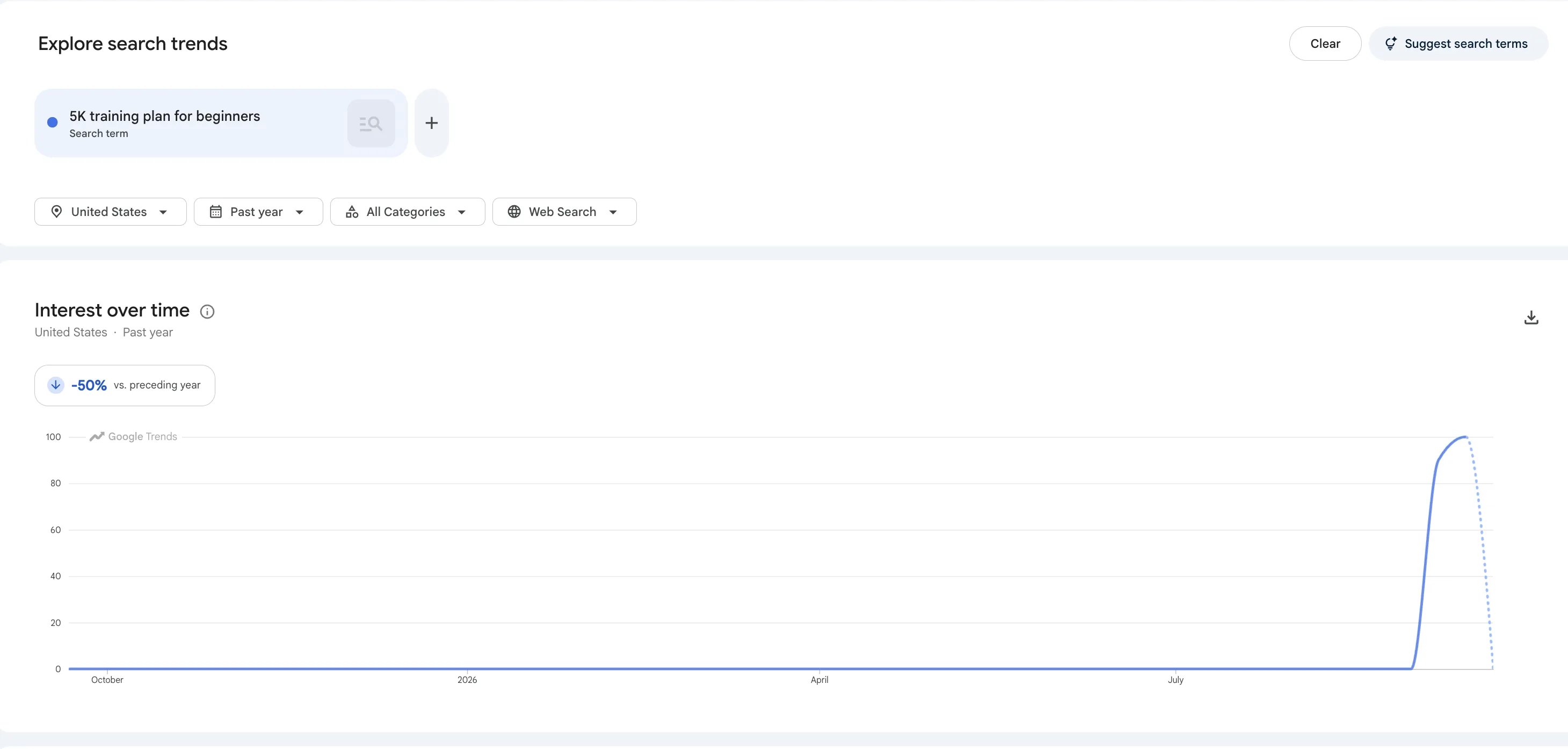
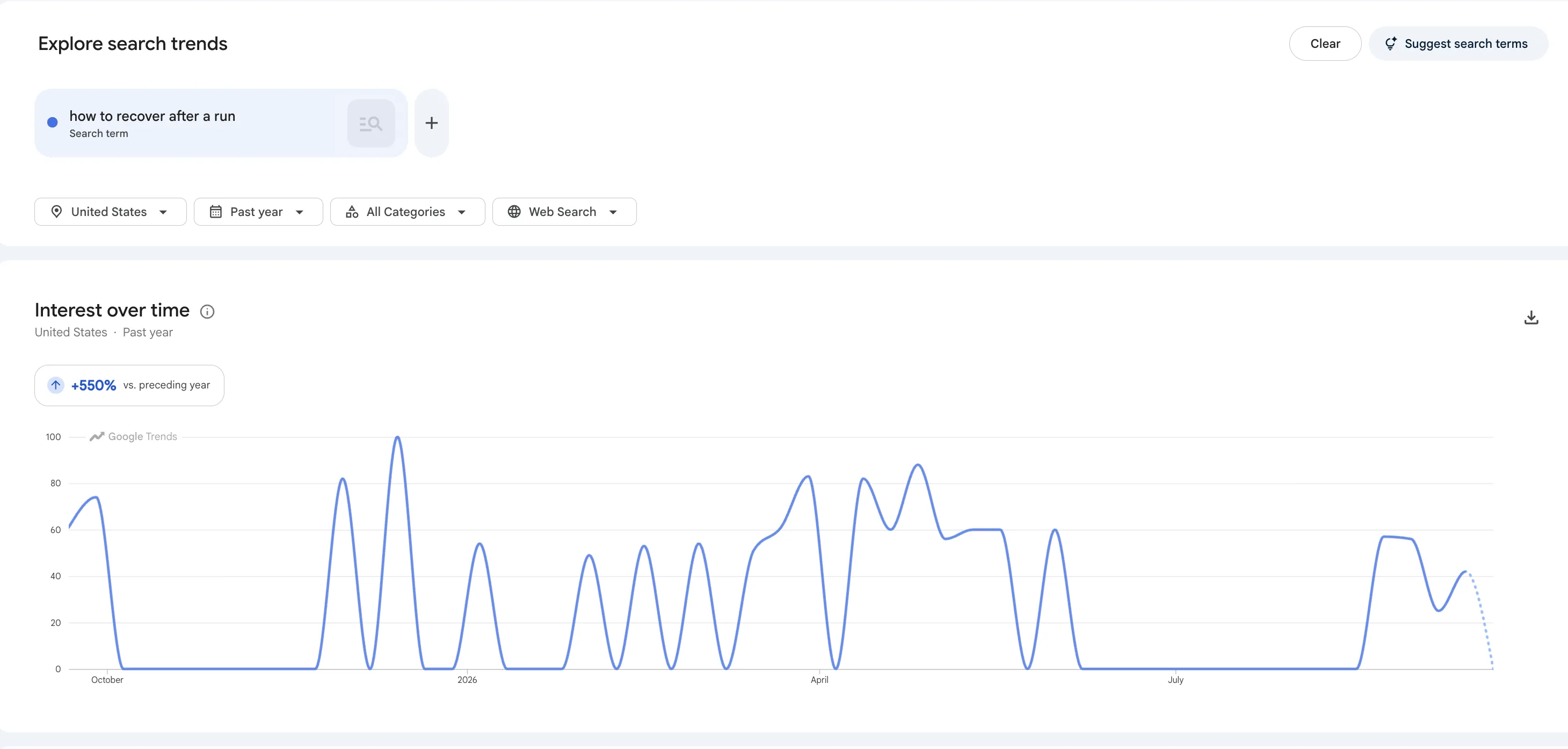
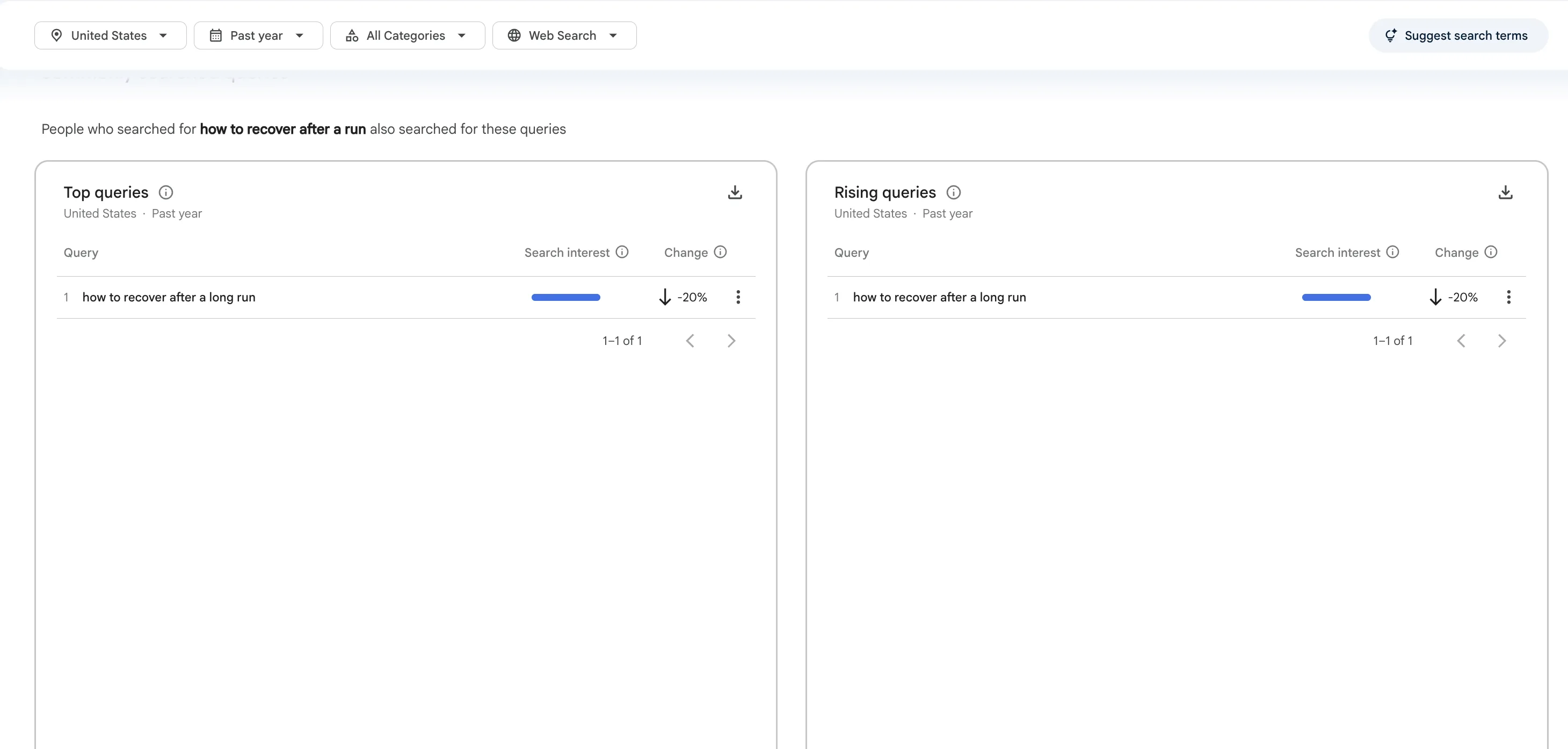
Two of the fifteen turned up a genuinely useful correction, supported by their related queries. "5K training plan for beginners" averaged 0 for nearly the entire year, but its only two related queries were "couch to 5k training plan" and "couch to 5k," suggesting that "couch to 5K" is the phrasing people use for that idea. It's also worth flagging on its own: in the final weeks of the period, "5K training plan for beginners" spiked sharply toward 100, a possible seasonal signal (fall training season) that a single annual average would hide entirely. "How to recover after a run" showed a similarly quiet average (2) inside its five-term comparison, but its only related query was "how to recover after a long run," suggesting that's the stronger phrasing. Viewed on its own rather than against "couch to 5k," "how to recover after a run" shows a repeated pattern of sharp spikes and drops through the year, one of them reaching 100, and much stronger interest than its five-term comparison suggested — another case where the batch comparison undersold a term relative to how people actually search for it. Building the pages as originally titled would have missed the phrasing people actually use.
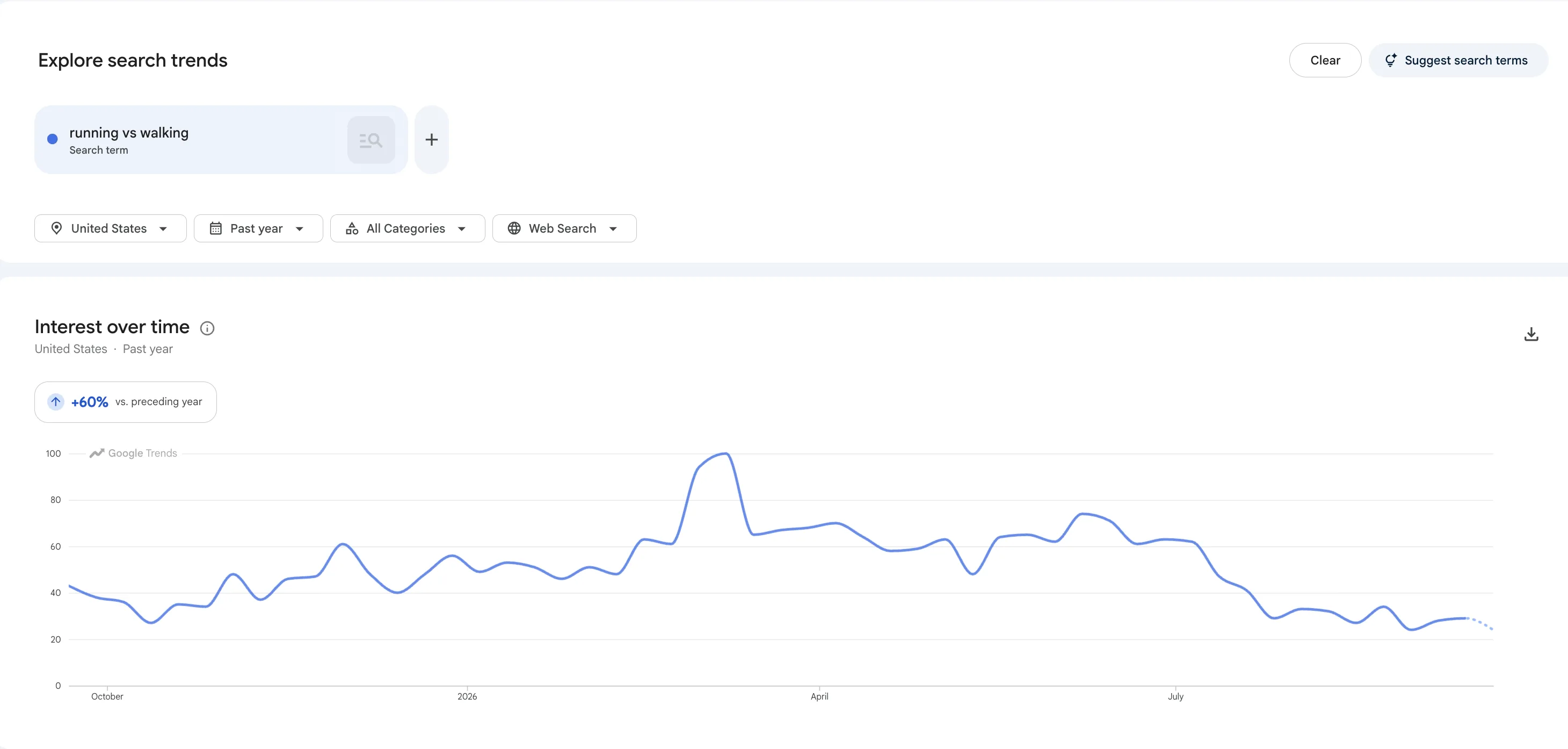
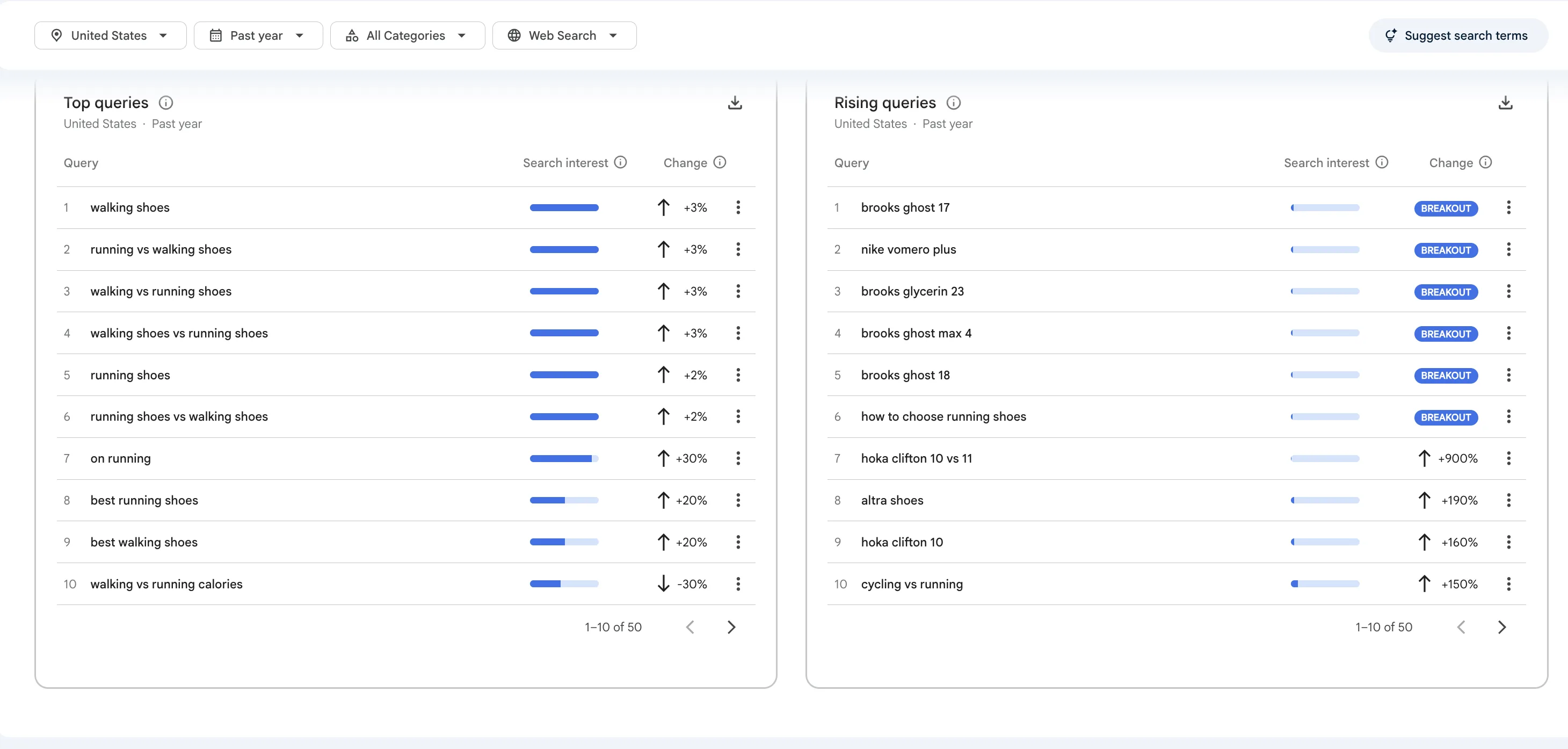
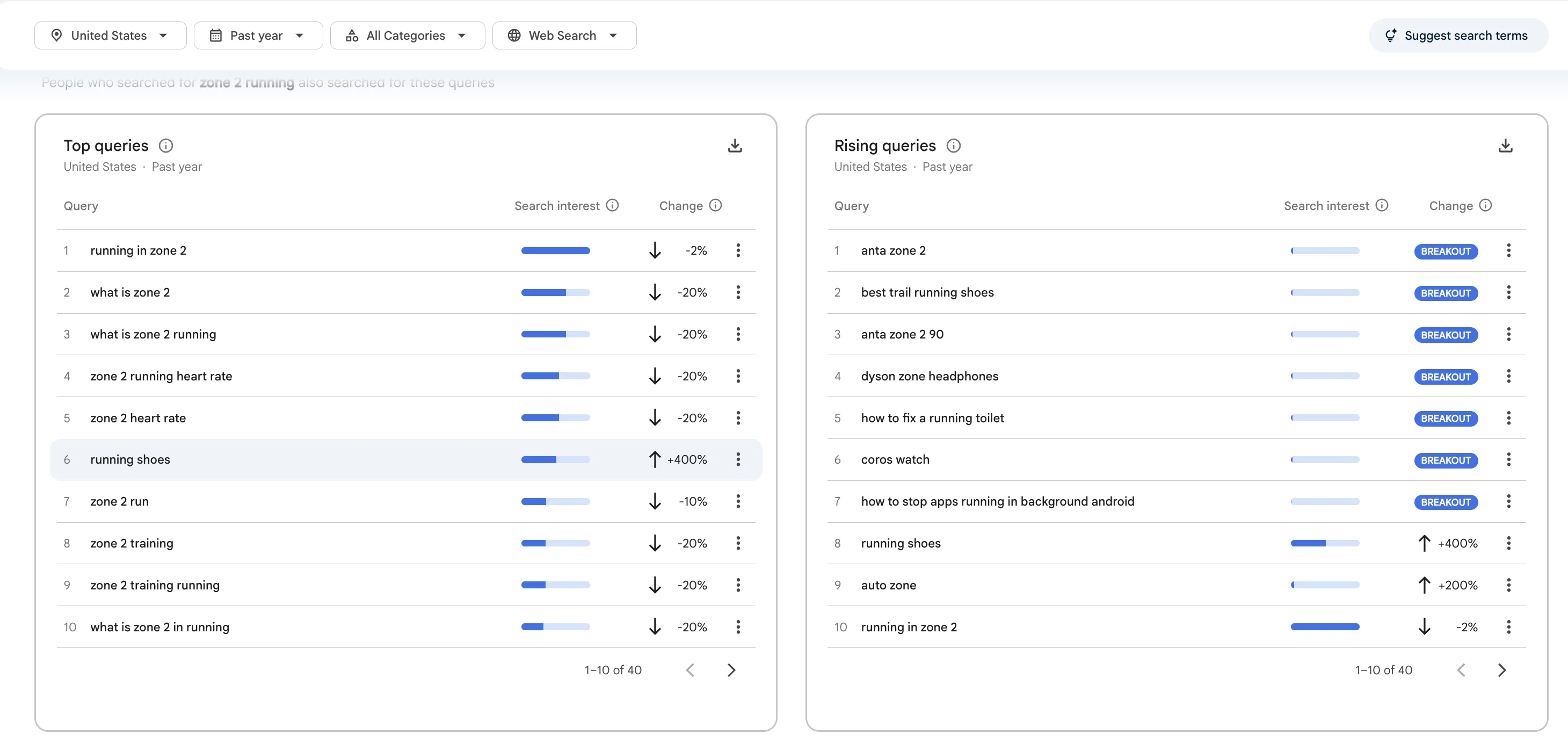
The data also came with real noise worth flagging rather than hiding. The related queries for "running vs walking" are dominated by shoe-model comparisons — walking shoes, running vs walking shoes, best running shoes — and rising breakout terms for specific models like the Brooks Ghost, Nike Vomero, and Hoka Clifton, not the activity comparison the title implies. "Zone 2 running" pulled in "how to fix a running toilet" as a rising breakout query, an unrelated use of the word "running," alongside other gear-brand noise (Anta Zone 2 shoes, Coros watches, Dyson Zone headphones). A generic keyword tool hands you all of this mixed together; deciding what actually belongs in the cluster is still a judgment call, not something the data does for you.
What Most Topic Cluster Guides Miss
Much topic-cluster advice focuses on "publish more connected content." What it often skips is knowing which sub-topics you're actually missing before you start writing, and knowing whether a competitor already has a cluster that outweighs whatever you're about to build. Publishing five more pages under a pillar you already have thin coverage on doesn't close a gap you haven't identified yet.
How RankAnalyze Shows You Topic Coverage and Gaps
The running example above took one pillar, three rounds of Trends checks, and real judgment calls to sort fifteen candidate titles into strong, weak, and mis-titled. That's a lot of manual work for one pillar, and it still only checked demand, not what a competitor already has published on the same sub-topics. Doing that by hand for every major topic on your site, against a named competitor, and re-checking it as you plan new content, means comparing pages side by side and risking missing one that's several clicks deep.
RankAnalyze's Ranking Audit maps relevant sub-topics around a pillar and checks which ones your site already covers, so the gap is visible before you plan the next page. Head-to-Head does the competitor half: which sub-topics a named competitor covers that you don't, and which sub-topics you cover that they don't. Together, they turn that manual check into a single report, for any pillar, against any named competitor.
RankAnalyze's Ranking Audit and Head-to-Head turn that side-by-side comparison into a single report: topic coverage, white space, and exactly which sub-topics a competitor covers that you don't.
Does This Matter for AI Search Too?
Nobody outside the AI companies knows exactly how much topical depth factors into what gets cited in an AI answer, and none of them have published a formula for it either. What's a reasonable inference, not a confirmed mechanism: a site with several linked pages covering a subject in depth gives an AI system more pages that could plausibly be retrieved or cited for the range of questions someone might ask about that subject, compared to a single page that only answers one version of the question. That's a different claim from saying topical authority is itself a ranking signal AI systems check for, it isn't confirmed to work that way, and treating it as a guarantee would be overstating what's actually known.
A Quick Topical Authority Checklist
- Do you have one page you'd call the pillar for this topic, or several competing pages with no clear main one?
- Have you mapped the real sub-topics your audience asks about, not just keyword variations of the same question?
- Does every cluster page link back to the pillar and to other relevant pages where useful?
- Before writing a new page, did you check whether an existing page already covers that sub-topic and just needs updating?
- Do you know which sub-topics a named competitor covers that you don't?
- Is anything in the cluster more than a year old without a recheck?
The Bottom Line
A topic cluster is a pillar page and a set of linked, deep sub-topic pages. Topical authority is a way of describing the broader credibility a site can build when it has accurate, useful coverage across a subject and connects that coverage well. It's not a switch that flips once you've published a certain number of pages. The part most advice skips is knowing which sub-topics you're actually missing, and which ones a competitor already owns, before you decide what to publish next.
Frequently Asked Questions
Is topical authority a real, confirmed ranking factor?
No search engine has published it as a named ranking factor with a formula attached. What's observable is a pattern: sites with deep, connected coverage of a subject tend to perform better across that subject's questions than a site with one isolated page. Treat it as a useful content strategy, not a documented algorithm input.
How is a topic cluster different from just publishing more content on a subject?
Structure and linking. A pile of unrelated pages about the same broad subject isn't a cluster if there's no clear pillar page and no deliberate linking between them. A useful topic cluster normally has all three: a pillar page, focused sub-topic pages, and meaningful links connecting them.
How many cluster pages does a pillar actually need?
As many as there are real, distinct sub-topics your audience asks about, no fixed number. A narrow pillar might need four or five. A broad one might need twenty. Forcing a round number of pages regardless of whether the sub-topics justify them usually produces thin, overlapping pages.
Should I rewrite old pages or write new ones to build out a cluster?
Check for an existing page on that sub-topic first. If one exists and is roughly accurate, updating and linking it is usually faster than starting over, and avoids two pages competing for the same intent. Write a new page only when nothing you have actually covers that sub-topic.
Does topical authority help with AI search the same way it helps with Google?
It's reasonable to expect that deeper, better-linked coverage gives an AI system more pages that could be retrieved or cited across a topic's range of questions, but that's an inference, not a confirmed mechanism either company has published. Don't treat it as a guarantee.
How do I know if my topical authority is actually working?
Track whether pages across the cluster are ranking and getting cited for a widening range of questions about the topic, not just whether the pillar page itself ranks for one keyword. A cluster that's working shows movement across several pages, not just one.
Do the internal links between cluster pages really matter that much?
Yes. Internal links help search engines understand how pages on your site relate to each other, and make it easier for users and crawlers to move between related pages. A set of unlinked pages can still cover the same subject, but the relationship between them is less clearly signaled.
See exactly which sub-topics you're missing — and which ones a named competitor already owns.