Content Marketing: How to Create Content People Actually Want
Content marketing is creating and sharing useful content that attracts people to your business, helps them solve problems, and gives them a reason to pay attention to you.
Not everything a company publishes is content marketing. A product page explains what you sell. An ad asks people to buy. Content marketing usually starts by giving the audience something useful — an answer, explanation, insight, comparison, story, or resource — before asking for anything in return.
Why Businesses Create Content
- Attract people who don't know you yet
- Educate people who are deciding
- Build trust with people who are deciding
- Stay connected to people who already bought
- Support sales without turning every piece into a sales pitch
A content calendar only tells you when to publish. Content marketing is the bigger job: deciding what to create, who it is for, where to publish it, and what you want it to achieve.
Start With the Audience, Not the Content Calendar
Start with a real person's question, problem, or interest. Don't start with a blank content calendar.
Start with what your audience cares about, the problems or questions they have, and the type of content that would genuinely help them. Everything else in this guide follows from that order.
Match the Format to What the Audience Wants
| Audience need | Possible content |
|---|---|
| Wants a quick answer | Blog post |
| Wants to learn something deeply | Guide / ebook |
| Wants to see how something works | Video |
| Wants to hear expert perspectives | Podcast |
| Wants original data or deeper evidence | Research / report |
| Wants practical help | Template / checklist |
| Wants to learn live | Webinar |
| Wants regular ideas | Newsletter |
| Wants quick, visual information | Social post / infographic |
| Wants proof before buying | Case study |
One Idea, Many Formats
A useful piece of content can often be turned into several smaller pieces instead of starting from scratch every time.
For example:
Research report → blog article explaining the findings → podcast discussion → LinkedIn posts → infographic → email newsletter → short video
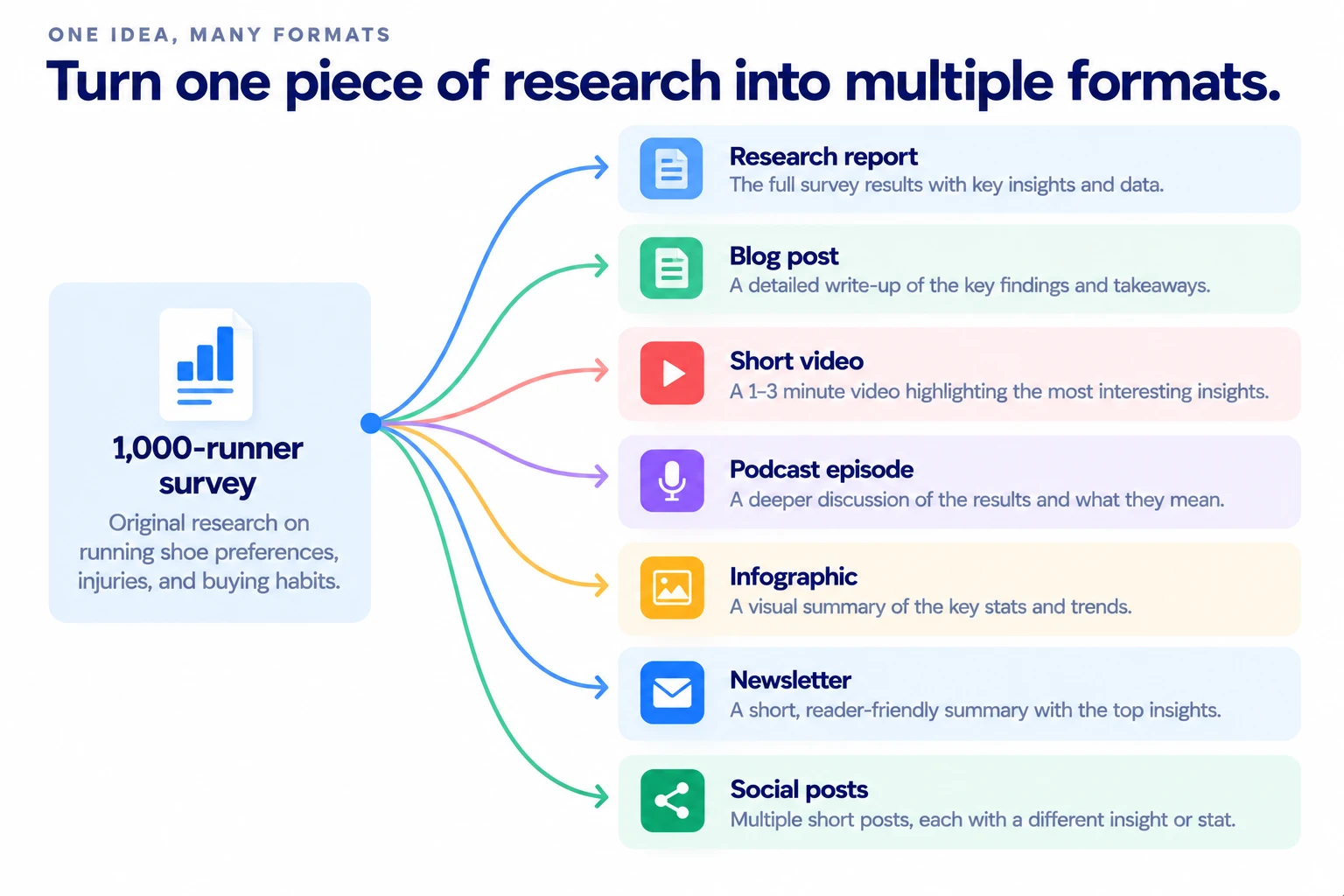
Imagine a running-shoe company surveys 1,000 runners about why they replace their shoes. The company could turn the findings into:
- A research report with the full results
- A blog post explaining the three biggest findings
- A short video explaining the findings
- A podcast episode discussing what surprised them
- An infographic with the key numbers
- A newsletter linking to the report
- Several social posts, each covering one finding
One piece of research becomes several useful pieces of content without inventing seven unrelated topics.
Not Every Piece of Content Needs to Sell Something
- Educational — "How to choose running shoes"
- Problem-solving — "Why your running shoes hurt your feet"
- Comparison — "Trail vs. road running shoes"
- Opinion/insight — "What we learned from 10,000 customer purchases"
- Product — "How our running-shoe fitting service works"
- Proof — "How a customer improved their running routine"
They serve different purposes. Some help people learn. Some help them compare options. Some show what your business can do.
Content marketing is not just blog posts
Content marketing can be a blog post, but it can also be a podcast, video, ebook, report, newsletter, webinar, case study, template, or social post. The right format depends on what you're trying to help the audience do.
Search Is One Way People Find Content
Someone might discover your content through Google, YouTube, LinkedIn, Instagram, Reddit, an email newsletter, a podcast, another website, or a recommendation from someone they trust.
So content marketing isn't:
keyword → article → Google traffic
It's:
Audience → useful idea → content → distribution → attention → relationship
Search is one way to understand and distribute content, not the whole framework. See What SEO Actually Means for how search itself works, and Generative Engine Optimization for how content can be discovered and referenced by AI answer engines — that's one discovery channel among several, not a replacement for the others.
Use Search Data to Discover What Your Audience Needs
Search data is one useful way to understand what people are looking for. It can help you find:
- What people are searching for
- What questions they're asking
- Which topics already have strong coverage
- Where the gaps are
See Keyword Research for the actual process of turning that into a real keyword list.
Look at What Already Exists Before You Create
Before creating something new, look at what already exists. Check the pages ranking for the topic, what competitors cover, and what your own site already answers. You may find that the opportunity is not a new article at all. It might be an outdated page that needs work, a question competitors barely answer, or two pages that should be combined.
See Topical Authority for how to map topic coverage and gaps, and Competitor Analysis for how to check what competitors cover.
Don't Publish One Piece and Forget It
Some content starts going out of date soon after it's published. Facts change, competitors publish new resources, and pages that once answered a question well can become less useful over time.
See Content Audit for a full framework on when and how to revisit what you've already published.
Measure What Matters for the Goal
A blog post might be measured by search visibility and useful traffic. A newsletter might be measured by opens, clicks, and subscribers. A case study might help sales conversations. The right metric depends on the job the content was meant to do — no single number proves a piece "worked."
The Content System, Put Together
Research → Create → Distribute → Measure → Improve
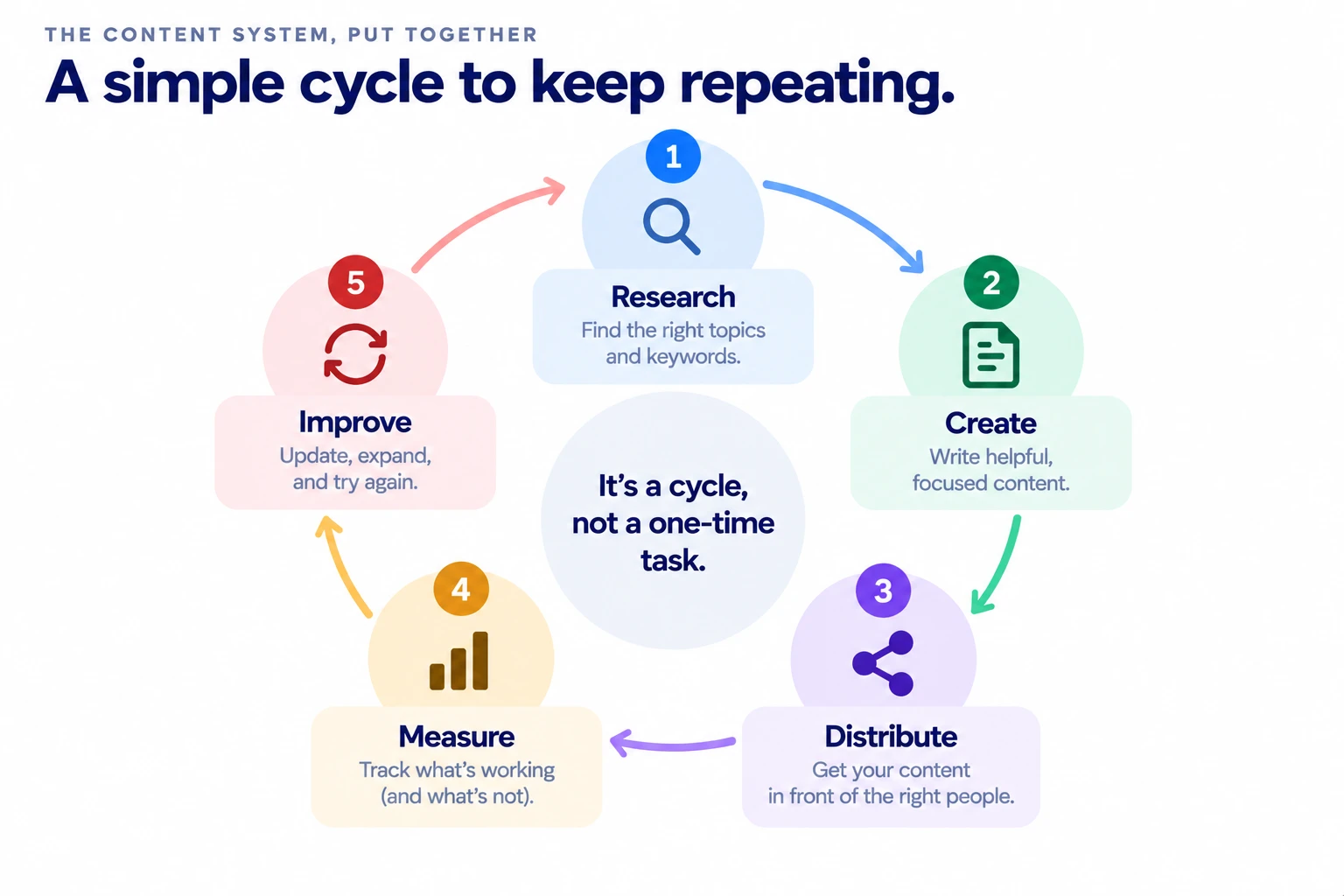
Create something useful. Put it where your audience can find it. See what happens. Then improve it.
Good content marketing starts with understanding what your audience needs. Search data can help you discover those needs, find gaps, and see whether your content is actually being found.
Frequently Asked Questions
Does every business need a blog?
No. A blog is one format among many. The right starting point is whatever format matches how your audience actually wants to learn — that might be video, a newsletter, or a podcast instead.
How often should you publish content?
There's no universal number. Consistency matters more than frequency — a schedule you can actually sustain beats a burst of publishing that stops after a month.
Should every piece of content target a keyword?
No. Some content exists to build trust, explain a product, or support sales conversations rather than to rank for a search term. Search is one distribution channel, not a requirement for every piece.
Can one piece of content be used on several channels?
Yes. A single piece of research or a single idea can become a report, an article, a video, and several social posts without starting from scratch each time.
How do you know whether content is working?
It depends on what the content was for. A blog post might be judged on search visibility, a newsletter on opens and clicks, a case study on whether it helps close deals. There's no single metric that proves content "worked" across every format.
See exactly how ChatGPT, Claude, Gemini, Perplexity and Copilot describe you today.